Ask ten sellers what metal business cards are made of and nine will say "metal" and move on. The honest answer is narrower. Almost every card on the market starts as stainless steel, and most of what looks like a different metal is a coating sitting on top of it.
The material decides how the card ages in a pocket, how deep the engraving can bite, and whether the chip inside it works at all. Two cards can look identical in a product photo and behave nothing alike after six months of daily carry.
The short answer: mostly stainless steel
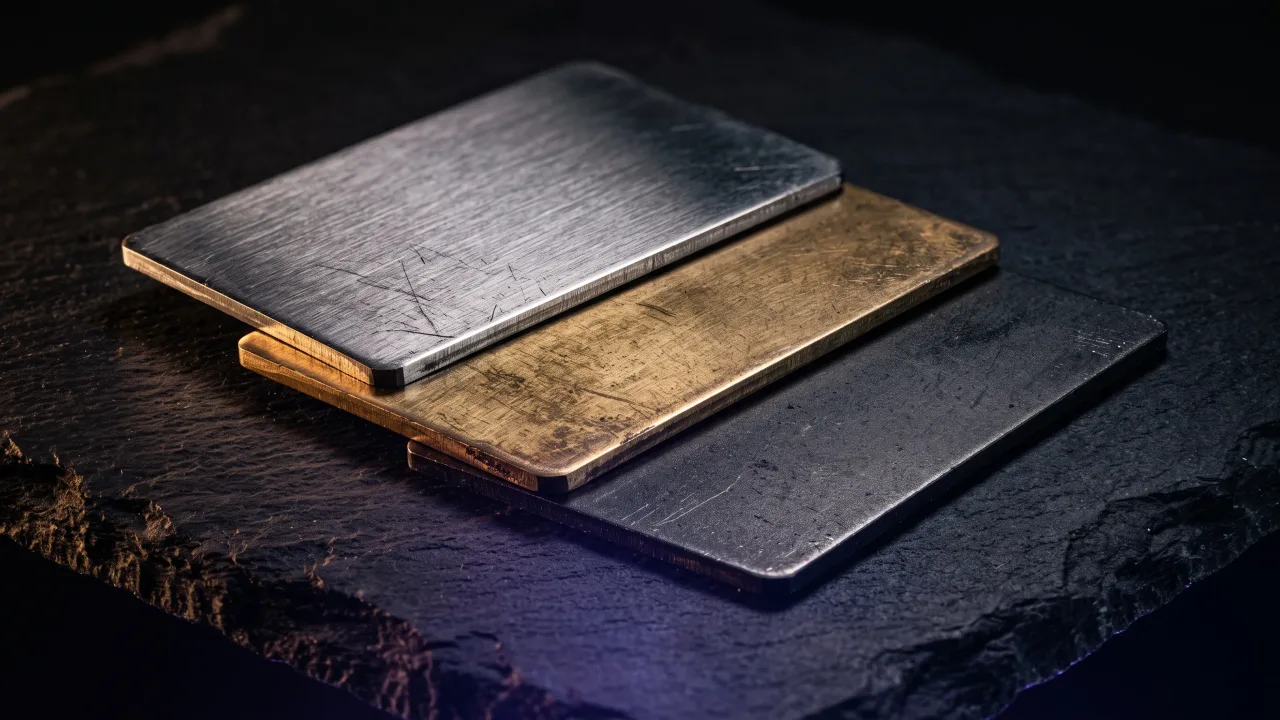
Four materials cover nearly the whole market. Stainless steel, brass, copper and aluminium. Steel is the base for the overwhelming majority, including every card sold as black, white, gunmetal or gold.
Precious metals exist at the top of the range. Gold plating, platinum, the occasional set stone. They are a rounding error in volume and priced like jewellery, so the four alloys below are what you are actually choosing between.
| Material | What it actually is | Best for | Watch out for |
|---|---|---|---|
| Stainless steel | Iron with about 18% chromium | Everyday carry, crisp engraving, NFC | Mirror finishes show fingerprints |
| Brass | Copper alloyed with zinc | Warm gold tone, deep etching | Tarnishes unless lacquered |
| Copper | Pure copper | Patina as a design choice | Darkens fast, dents easily |
| Aluminium | Light alloy, anodised for colour | Bright brand colours | Bends, feels light in the hand |
| Coated steel | Steel plus PVD or powder coat | Black, white and gold looks | Quality lives in the coating |
Stainless steel, and why it wins by default
Most cards use grade 304, the same alloy as a good kitchen sink. It is iron with roughly 18% chromium and 8% nickel, and the chromium is why it does not rust. It reacts with air to form an invisible oxide skin that reforms itself wherever the surface gets scratched. The full composition of grade 304 stainless is public and unglamorous, which is part of the appeal.
Steel is hard enough to hold a crisp engraved edge. A fiber laser vaporises the surface rather than scoring it, and the mark stays sharp because the metal around it never deforms. Softer alloys round off at the edges of fine text, which you notice first in small type and hairline rules.
Weight carries the rest of the argument. Run the density numbers on a 0.8 mm card in standard CR80 credit-card format and steel lands near 29 grams, against under two grams for heavy card stock. That gap is the whole reason metal cards end up on a desk instead of in a bin.
Grade 316 shows up in marketing copy as "marine grade". It resists salt water better. Unless you plan to hand out cards on a trawler, it buys you nothing you can feel.
Brass and copper: the warm metals
Brass is copper alloyed with zinc, and the ratio sets the colour, from pale yellow through deep gold. It is softer than steel, which makes it the favourite for deep etching, where the design is cut well below the surface and flooded with enamel.
The trade is tarnish. Bare brass darkens as it oxidises, at a speed that depends on how much it gets handled. Some buyers want exactly that. If you don't, the card needs a lacquer, and lacquer scratches.
Copper does the same thing faster and more dramatically, moving from bright pink to brown inside a few months. It also dents, because pure copper is soft enough to mark against a set of keys. Treat the antimicrobial claims some sellers attach to it as decoration rather than a reason to buy.
Rose gold is usually neither metal. On most cards it is a finish applied to steel, which is why it keeps its colour while genuine copper does not.
Aluminium: light, colourful, and usually a compromise
Aluminium has one genuine advantage. Anodising dyes the surface in colours steel cannot hold, so if a card has to match a specific brand red, this is the route to it.
Everything else argues the other way. It bends under pocket pressure and dents on a corner drop. It also weighs about a third of what steel does, and the hand reads that as cheap even when the finish is good. It rarely comes out cheaper either, once anodising is priced in.
Black, white and gold are finishes, not metals
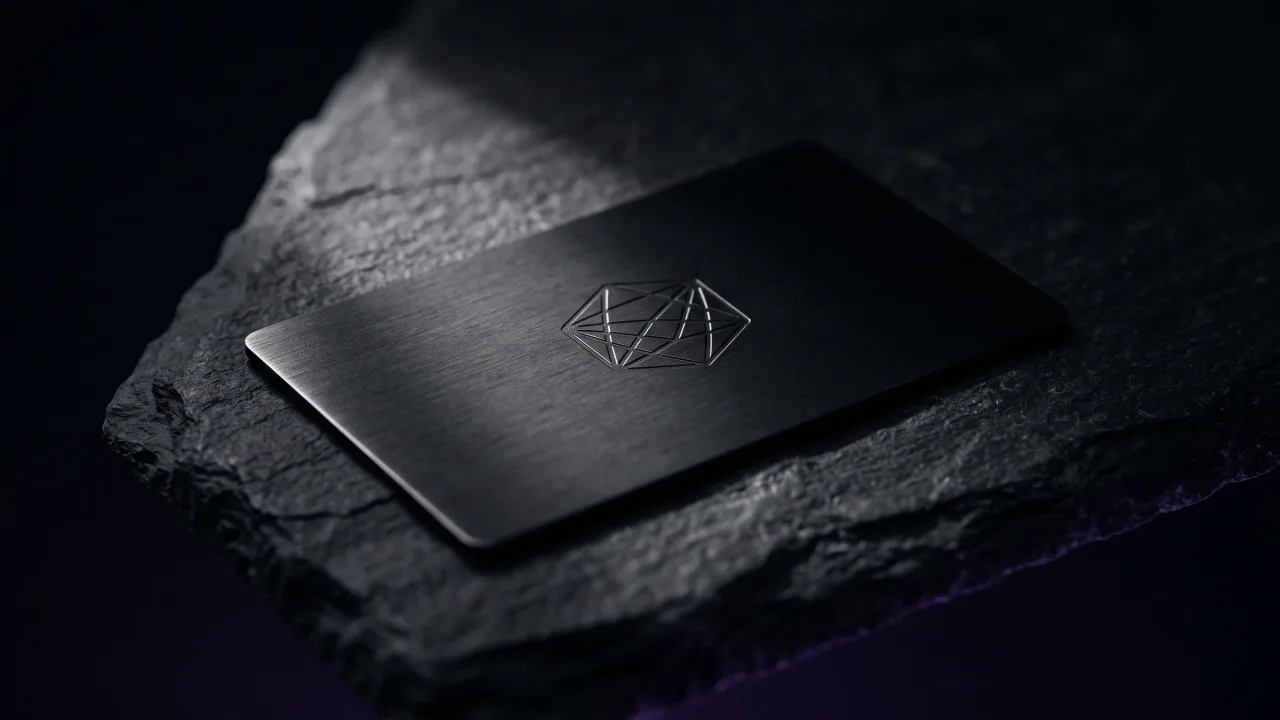
A black metal business card is stainless steel wearing a coat. Depending on the maker, that coat is PVD, a vacuum-deposited ceramic layer measured in microns, or powder coat, a thicker polymer baked onto the surface. PVD is harder and thinner. Powder coat costs less and chips more readily at the edges.
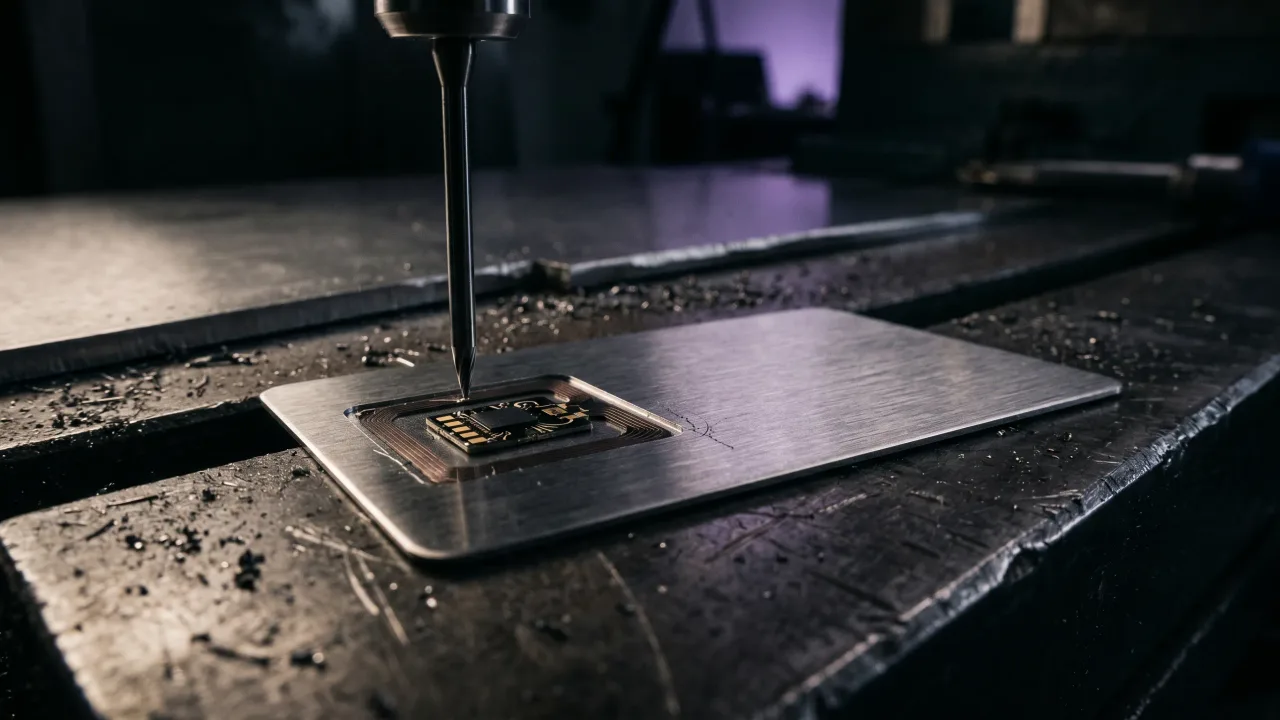
Coating is also why engraving on a black card looks so sharp. The laser burns through the dark layer and exposes bright steel underneath, so the contrast is physical rather than printed. Our walkthrough of how metal NFC cards are made covers what that looks like on the line.
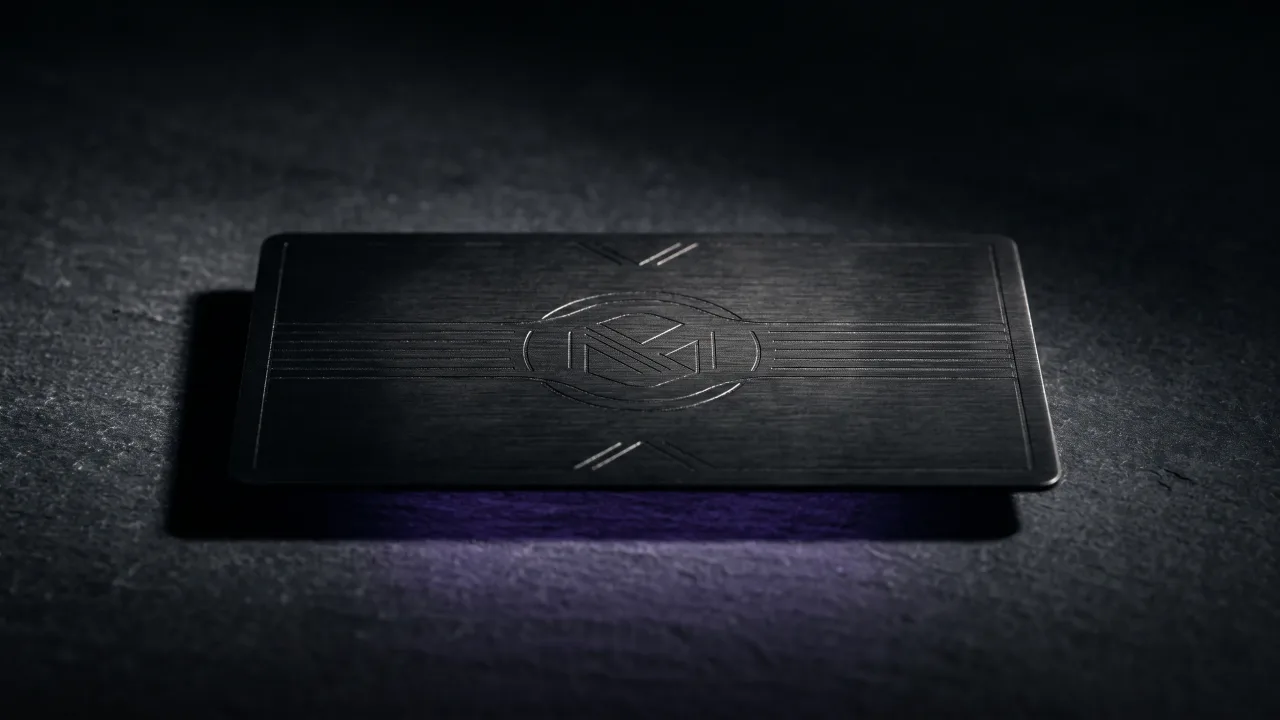
Fingerprints are the honest downside. Matte black shows finger oils more than brushed steel, and mirror finishes are worse than both. If the card comes out of a jacket three times a day, brushed hides wear best. The design gallery shows how each surface behaves under light.
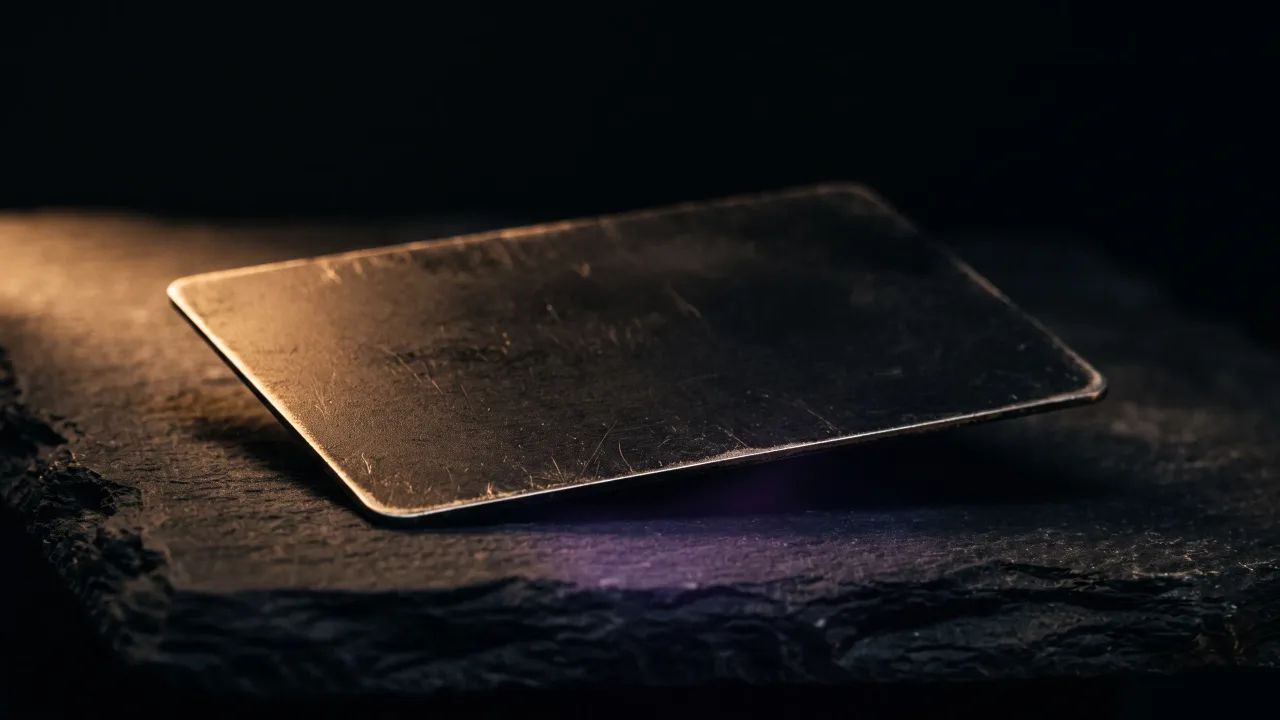
There is a quick way to tell a coating from a solid metal. Look at the cut edge under good light. A coated card shows a hairline of bright steel where the blade or laser went through, because coatings sit on the faces rather than wrapping the perimeter. A solid brass or copper card is the same colour on the edge as on the face, all the way through. Anodised aluminium is the confusing case, since the dye penetrates the surface layer and the edge looks continuous even though the metal underneath is grey.
Wood, carbon fibre and the near-metal options
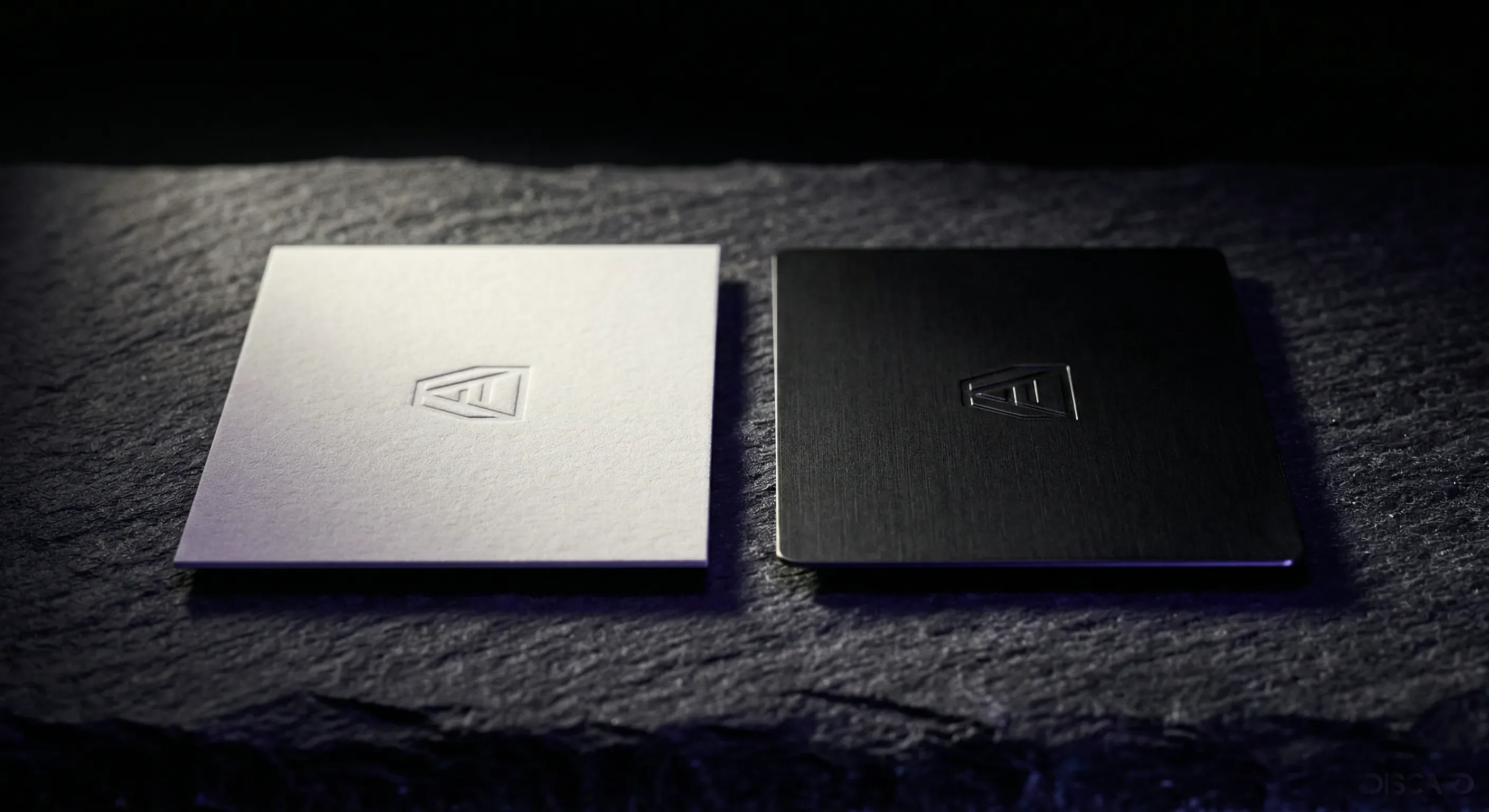
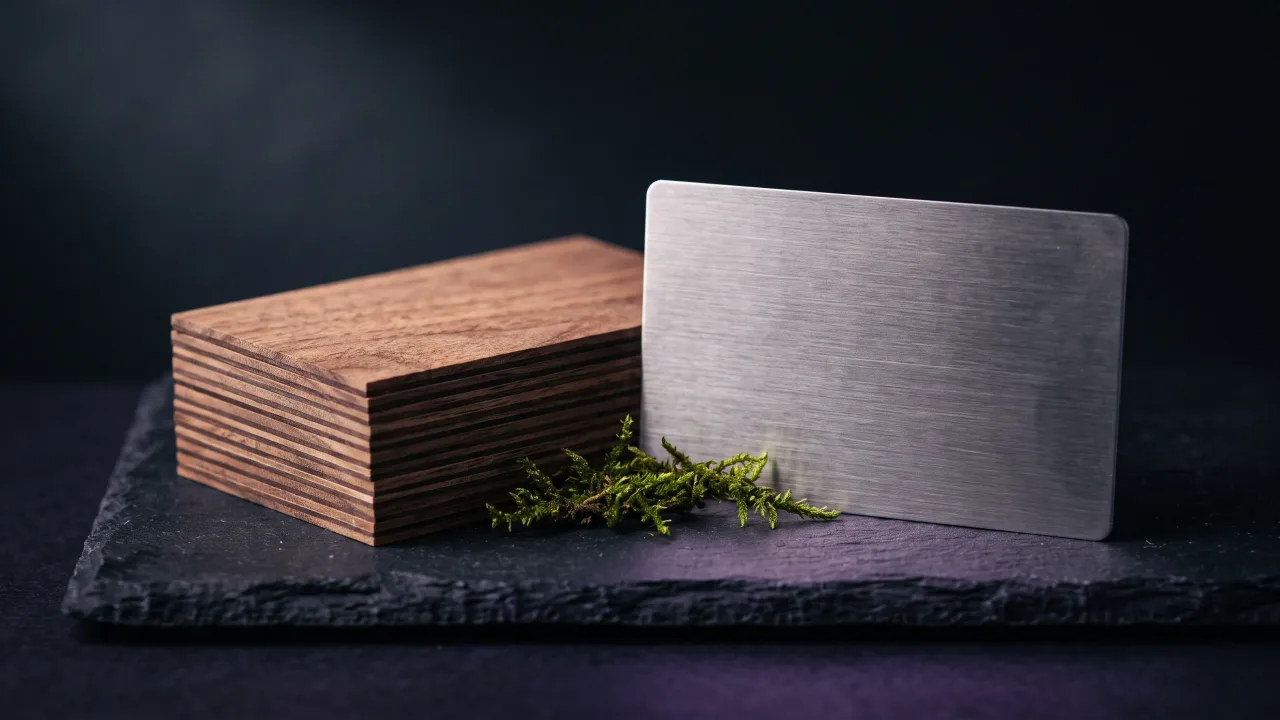
Wood is the only non-metal that competes on feel. Walnut, maple and birch cut cleanly under a CO₂ laser, and the burn becomes part of the grain rather than ink sitting on top of it. Wooden cards run thicker, around a millimetre, because the section has to stay rigid.
Carbon fibre occupies a strange middle. Lighter than aluminium, stiffer than steel for its weight, and poor to engrave, since the laser exposes the weave instead of cutting a clean line.
Both matter for a reason beyond looks. Neither one interferes with the chip. Solid metal is where that gets complicated.
What the metal does to the NFC chip
Lay an antenna flat against a sheet of steel and it stops working. The phone's field induces eddy currents in the metal, those currents throw off a field of their own, and the tag detunes until nothing reads.
Two fixes exist and both cost money. Either a ferrite layer goes between chip and metal to absorb the interference, or the metal is machined with a cavity so the antenna sits in a non-conductive window. Cheap metal cards skip both, glue a sticker tag to the back, and hope.
- A steel card with a properly isolated NTAG 215 reads from a couple of centimetres, every time, on any phone with NFC.
- A tag glued to bare metal reads intermittently and gets blamed on the recipient's phone.
- Wood and carbon fibre need no isolation at all. Budget makers gravitate to them for exactly that reason.
- Coatings are too thin to matter either way; PVD and powder coat are transparent to radio.
This is the question worth asking a supplier before the material one. Our hardware specification lists the chip, the format and the tolerances, and the digital profile is what the chip actually opens.
Which material should you actually choose?
For most people, stainless steel with a brushed or coated finish. It survives keys, it engraves cleanly, it needs no maintenance, and price is its only real drawback.
Choose brass if the gold tone is the point and you accept a card that ages visibly. Copper only makes sense when the patina is something you want. Skip aluminium unless you need a colour nothing else produces.
Wood is a real choice rather than a budget one. It sits lighter in the hand, it reads as deliberate, and it suits work that is warm rather than technical. The configurator renders every material we make with your own name engraved on it, which tells you more than any swatch will.
The material question has a boring answer and a useful one. The boring answer is stainless steel, because it is what almost everyone makes and almost everyone makes it competently. The useful answer is that the alloy is rarely what separates a good card from a bad one. Coating quality, engraving depth and whether the antenna was engineered into the card or glued onto the back decide far more of the experience. Ask a supplier what grade of steel they use and you will get an answer off a spec sheet. Ask how they isolate the chip from the metal and you will find out whether they built the card or bought it in a box.
See every material we make with your own name engraved on it, before you spend anything.
Open the configuratorWhat metal are most business cards made from?
Stainless steel, usually grade 304. It resists corrosion, holds a laser engraving without deforming, and takes coatings well. That last property is why black, white and gold cards are almost always steel underneath.
Is stainless steel or brass better for a business card?
Steel for durability, brass for colour and depth of etch. Brass is softer, so it takes a deeper cut and fills well with enamel, but it tarnishes unless it is lacquered. Steel needs nothing done to it.
Are metal business cards magnetic?
Barely. Grade 304 stainless is austenitic, so it responds only weakly to a magnet, and brass, copper and aluminium do not respond at all. None of them will affect a hotel key or a bank card sharing the same pocket.
Do metal business cards rust or tarnish?
Stainless steel does neither in normal use, because the chromium in the alloy forms a self-repairing oxide layer. Brass and copper tarnish by design and will darken within months of handling. Coated steel stays as it is until the coating chips.
Does metal block the NFC signal?
It does, unless the card is built to compensate. Metal induces eddy currents that detune the antenna, so a working metal NFC card either carries a ferrite layer between chip and metal or a non-conductive window cut into the body. Ask any supplier which of the two they use.
Can I take a metal business card through airport security?
Yes. Metal cards go through the scanner in a tray or a bag like any other object, and at under a millimetre thick they read as unremarkable. Keep them in a wallet rather than loose in a pocket and they attract no attention.
Are metal business cards recyclable?
Yes. Steel, brass, copper and aluminium all go through ordinary scrap streams, and steel is among the most recycled materials on earth. A coated card still goes in with the metal, because smelting separates the coating out.