From 27 September 2026, EU consumer law stops letting sellers call a product eco-friendly without proof behind the word. That is a little awkward for an article with those words in its title, and quite useful for anyone trying to buy one.
Eco friendly business cards cover a wide spread of objects: recycled card stock, cotton paper, paper with seeds pressed into it, thin wood, engraved steel, and cards that never get printed at all. A few of them earn the label. Others have a kraft-brown colour and a leaf icon and not much else. We make metal and wood NFC cards, so we have a side in this, and we will say plainly where our materials lose.
What makes a business card eco friendly
Three things decide it. What the card is made of, how many of them you get through, and where each one ends up. Vendors talk almost entirely about the first. The second usually matters more.
A box of 250 cards on 100% recycled stock is still 250 objects. If your phone number changes in March and you bin the 180 you had left, the recycled fibre did not save much. The waste in business cards was never mainly the paper. It was the reprints.
So the honest version of the question is less "which stock is greenest" and more "how few cards can I get away with making". Every option below looks different once you ask it that way.
The EU rule that changes the word eco-friendly
The rule is Directive (EU) 2024/825 on empowering consumers for the green transition. National laws implementing it apply from 27 September 2026.
It bans generic environmental claims such as "eco-friendly", "green" or "climate friendly" unless the seller can show recognised excellent environmental performance, for example a product that meets the EU Ecolabel criteria. It also bans sustainability labels that are not backed by a certification scheme or a public authority, and claims that a product is climate neutral because somebody bought carbon offsets.
Specific claims survive. "Printed on 100% recycled stock, FSC Recycled certified" tells you something you can check. "Eco card" next to a green leaf does not. Hold every product page in this category to that standard, ours included.
Recycled and FSC-certified paper
This is the most common eco option and, for low volumes, one of the most defensible. Recycled stock reuses fibre that has already been through the system once, and it prints well.
Look for the certification rather than the adjective. The Forest Stewardship Council runs three labels, and the FSC explains exactly what each one means: FSC 100% is fibre from certified forests, FSC Recycled is made entirely from recycled material, and FSC Mix blends the two with controlled wood. A printer who uses the logo should be able to give you the licence code. "Contains recycled content" without a percentage can mean very little.
The catch is the finish. Plastic lamination, metallic foil and heavy coatings are what make a paper card feel expensive, and they are also what makes it hard to recycle. The paper card that feels most premium in the hand is often the one least likely to be recycled after it is thrown away.
Cotton, hemp and seed paper
Cotton paper is made from linters, the short fibres left clinging to cotton seeds after the long ones go off to become textiles. It is a by-product, which is a good start, and it gives a thick, soft card that takes letterpress beautifully. Hemp paper sells on a similar tree-free story.
Tree-free does not automatically mean lower impact, though. How the fibre was pulped, bleached and shipped counts for more than which plant it came from. Ask the same questions you would ask of recycled stock: which certification, made where, finished with what.
Seed paper is the charming one. Wildflower or herb seeds are pressed into the pulp, and the idea is that your contact plants your card. Two problems. Seed paper is lumpy, so small type and fine logos print badly on it. And it is hard to picture many people planting a business card, so it tends to end up in the same bin as everything else. It is also a strange brief for an object whose whole job is to be kept.
Wood and bamboo cards
Wood cards are usually laser engraved rather than printed, so there is no ink layer at all. They are sturdier than paper and nicer to hold, and people keep them, which is the point.
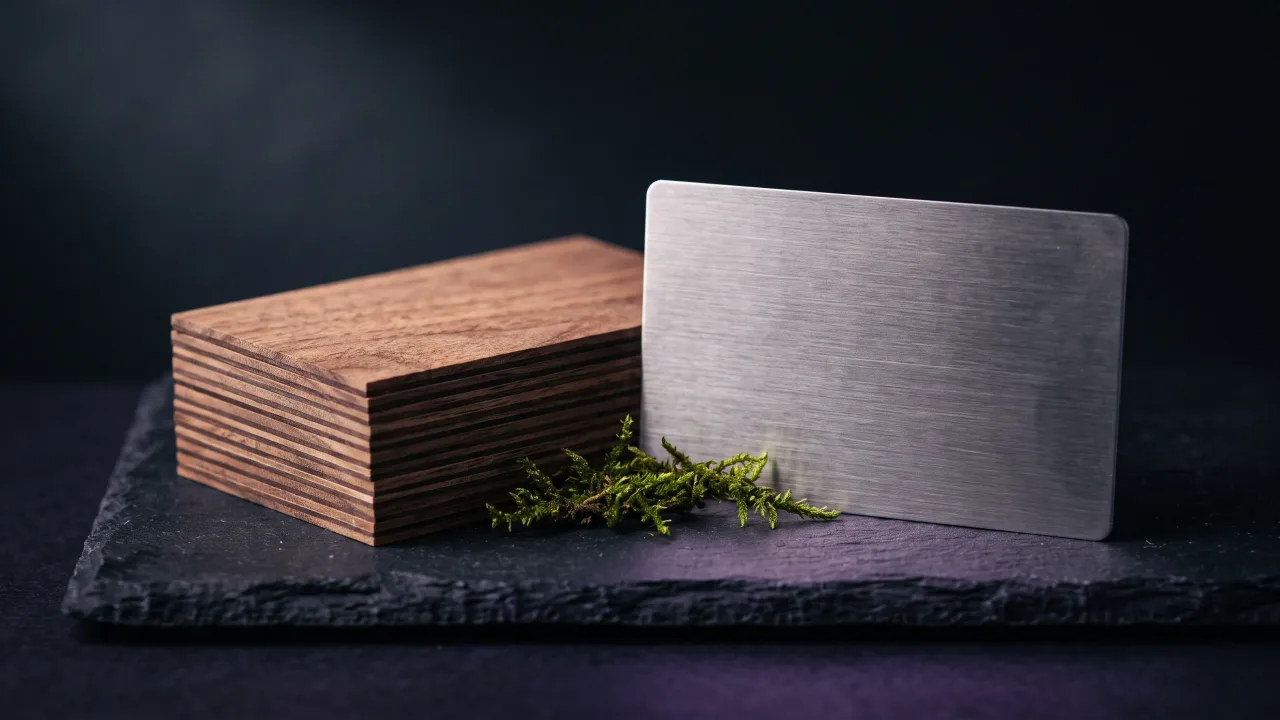
Check whether a wood card is solid veneer or a composite. Thin solid wood can split along the grain, so many durable wood cards, ours included, are a wood composite rather than a single sheet. Our walnut, birch and maple cards are 1.2 mm thick and weigh 8 to 12 grams. The composite is what makes them last, and it also means you should not expect to put one on a compost heap.
Bamboo cards make the fast-growing-plant argument, which is fair as far as it goes. The same questions about processing and transport apply, and a bamboo card only beats paper if it replaces a stack of paper.
Plastic NFC cards and the PVC question
Many budget NFC business cards are PVC, the same plastic as a hotel key card. They are durable, and a card that replaces several years of reprints still sends fewer objects into the world than paper does.
They are also the weakest material story among reusable cards. A PVC card with a chip and a metal antenna laminated inside is a small composite of plastic and electronics, and no ordinary recycling bin is set up for it. If you are choosing a reusable card partly for environmental reasons, plastic is the version that undercuts the reason.
Metal cards: heavier to make, lighter over time
Metal card sellers tend to skip this bit. One of our stainless steel cards weighs 25 to 30 grams. A standard 350 gsm paper card weighs about 1.6 grams. By weight, one metal card is roughly a stack of 15 to 18 paper cards, and each gram of steel carries more carbon from production than a gram of paper. A metal card starts out behind.
It catches up by never being reprinted. The card holds a link, and the details live on a profile you edit, so a new job title costs an edit rather than a box. An active networker reprints several times a year, and our breakdown of what paper cards really cost has that arithmetic. Over three or four years, one card against several boxes is not a close contest.
The end of the story is better than the start, too. Stainless steel recycles very well, and the industry body worldstainless reports that at least 95% of stainless steels are recycled at end of life. The chip is the fiddly part, so a metal card with NFC is not quite as simple as a spoon. What metal business cards are made of goes through the steel, the coatings and the chip.
The honest limit: if you hand out 40 cards a year and have had the same phone number since 2011, a small run of recycled paper will have a lighter footprint than any metal card. Metal only wins when it replaces reprints.
| Option | Made from | When your details change | End of life | Best for |
|---|---|---|---|---|
| Recycled paper | Recovered fibre | Reprint the box | Paper recycling if uncoated | Low volume, stable details |
| Cotton or hemp paper | Tree-free fibre | Reprint the box | Paper recycling if uncoated | Letterpress, occasional use |
| Seed paper | Pulp with seeds | Reprint the box | Planted, in theory | One-off events |
| PVC NFC card | Plastic and a chip | Edit the profile | Hard to recycle | Tight budgets |
| Wood NFC card | Wood composite and a chip | Edit the profile | Not compostable | Kept for years |
| Metal NFC card | Stainless steel and a chip | Edit the profile | Steel is widely recycled | Heavy networking, changing roles |
| Digital only | Nothing physical | Edit the profile | Nothing to throw away | Email and video calls |
Digital-only: the card that is never printed
The lowest-footprint business card is a profile page with a QR code in your email signature or phone wallet. Nothing is manufactured and nothing ends up in a bin. Hosting a web page uses some electricity, but there is no object in the equation.
What you give up is the handover. Meeting someone in person and pointing them at a QR code on your phone screen works, and it feels like a workaround. That is why most people land on a hybrid: one physical card, kept for years, that opens a digital profile you update yourself.
How to check an eco claim before you order
Six questions cover almost every product page in this category.
- Which certification is it, and can I see the licence code?
- What percentage is recycled, and is it post-consumer fibre?
- Is there any plastic laminate, foil or coating on the card?
- Where is it made, and how far does it travel to reach me?
- How many will I realistically hand out before my details change?
- For an NFC card, does it keep working if I stop paying, or does it become waste?
The last one catches people out. A card tied to a subscription that stops working when you cancel is a very short-lived object dressed as a durable one. NFC business cards without a subscription explains how to tell the difference.
Our own answers, so you can apply the test to us: the cards are made in Bulgaria and shipped within the EU, engraved by fibre laser rather than printed, in stainless steel or wood composite, and the full list of materials and weights sits on the specs page. We do not call them eco-friendly, and under the new rules we would need proof we do not have before we could start.
Most people searching for eco friendly business cards need fewer cards more than they need a greener box. If you hand out a few dozen a year and your details rarely change, buy uncoated recycled stock with an FSC Recycled logo, skip the foil, and order the smallest run the printer allows. That is the lightest physical option and it is cheap. If you network constantly or your role keeps moving, one durable card you keep for years beats any paper stock, because the reprints were always the real waste. Avoid PVC if the environment is part of your reason for switching. And treat any card sold as eco with nothing specific after the word as unproven. From 27 September, EU consumer law treats it that way too.
Design one wood or metal card, engraved once, with details you edit online instead of reprinting.
Design your cardWhat is the most eco friendly business card?
A digital-only card, because nothing is manufactured. Among physical cards it depends on volume. For a few dozen cards a year, uncoated FSC Recycled paper is the lightest choice, while for heavy use one durable card that is never reprinted comes out ahead.
Are metal business cards eco friendly?
Not on day one. A metal card weighs as much as 15 to 18 paper cards and steel carries more carbon per gram to produce. It comes out ahead only when it replaces years of reprints, and stainless steel is widely recycled at end of life.
Can business cards be recycled?
Plain, uncoated paper cards can usually go in paper recycling. Laminated, foiled and heavily coated cards generally cannot, and neither can plastic ones. Cards with an embedded NFC chip are not ordinary paper or plastic waste, so check your local rules before binning one.
Is seed paper good for business cards?
It suits one-off events and brands built around gardening or nature. Its rough surface blurs small type and fine logos. Most recipients never plant it, so in practice it is often thrown away like any other card.
Can a company still call its business cards eco-friendly in the EU?
Only with proof, at least when selling to consumers. Under Directive (EU) 2024/825, applying from 27 September 2026, generic claims like eco-friendly or green are banned unless the product shows recognised excellent environmental performance, such as meeting EU Ecolabel criteria. Specific, verifiable claims such as a named certification are still allowed.
Are NFC business cards eco friendly?
They can be greener than paper if you keep one card for years and update the linked profile instead of reprinting. The material matters: wood and steel cards last and steel recycles well, while PVC cards are plastic. A card that stops working when a subscription ends loses most of the benefit.
Do eco friendly business cards cost more?
Recycled stock is usually priced close to standard card. Cotton, hemp and seed papers carry a clear premium. A reusable NFC card costs more upfront but removes reprint costs, which is where paper cards get expensive.