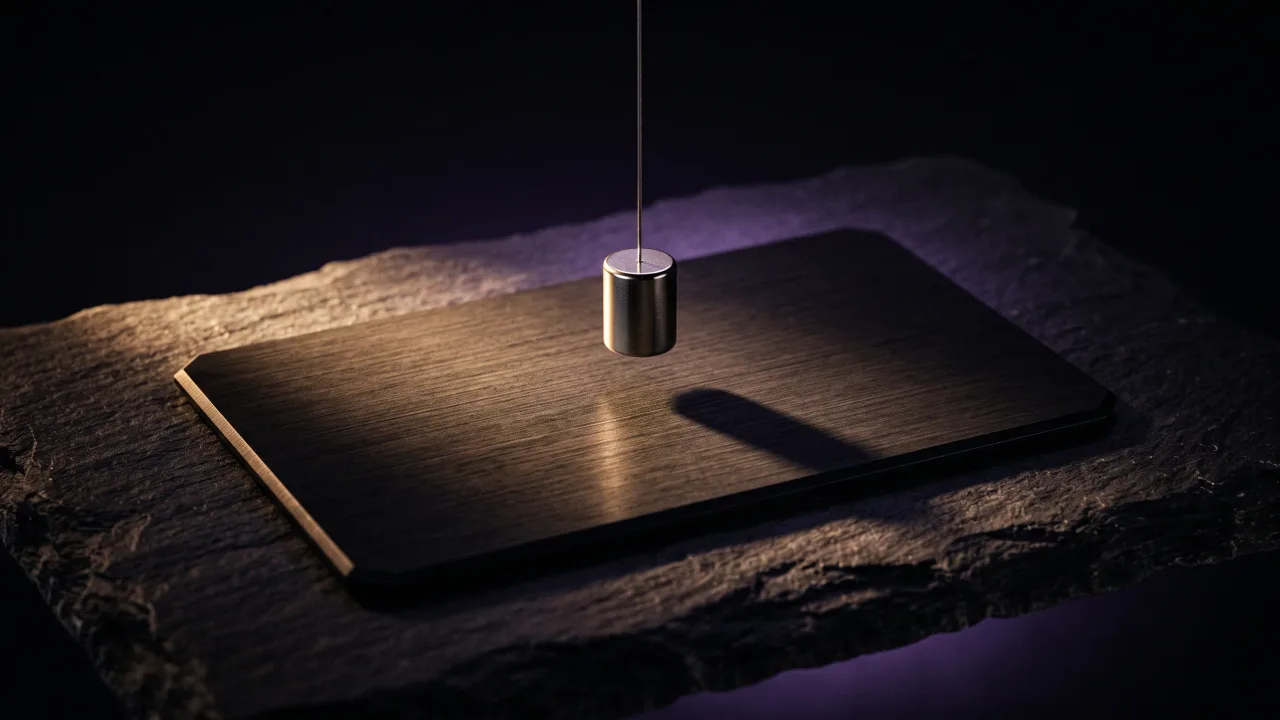
Hold a fridge magnet against a stainless steel business card and, most of the time, nothing happens. No pull. No click. People find that genuinely surprising, because metal and magnetic sound like the same word, and because the question usually arrives attached to a wallet full of bank cards.
So are metal business cards magnetic? Almost never in the way that matters. Most are cut from austenitic stainless steel, which barely reacts to a magnet at all. And even the ones that do stick to a fridge carry no magnetic field of their own, which answers the question hiding underneath the question: nothing in your wallet is at risk.
The short answer, and the worry behind it
Two different people ask this. One wants a card that clings to a client's fridge for six months. The other has just been handed a heavy steel card and is deciding whether to put it next to a hotel key.
Both answers are short. A standard metal business card will not hold itself on a fridge, because the steel used to make it belongs to the non-magnetic family. And it cannot erase a magnetic stripe, because being pulled by a magnet and being a magnet are two unrelated properties.
A paperclip makes the point. It jumps to a magnet instantly. Leave one sitting on a credit card for a year and the stripe still reads fine on day 365. Metal cards behave the same way, only less so.
Why stainless steel is only sometimes magnetic
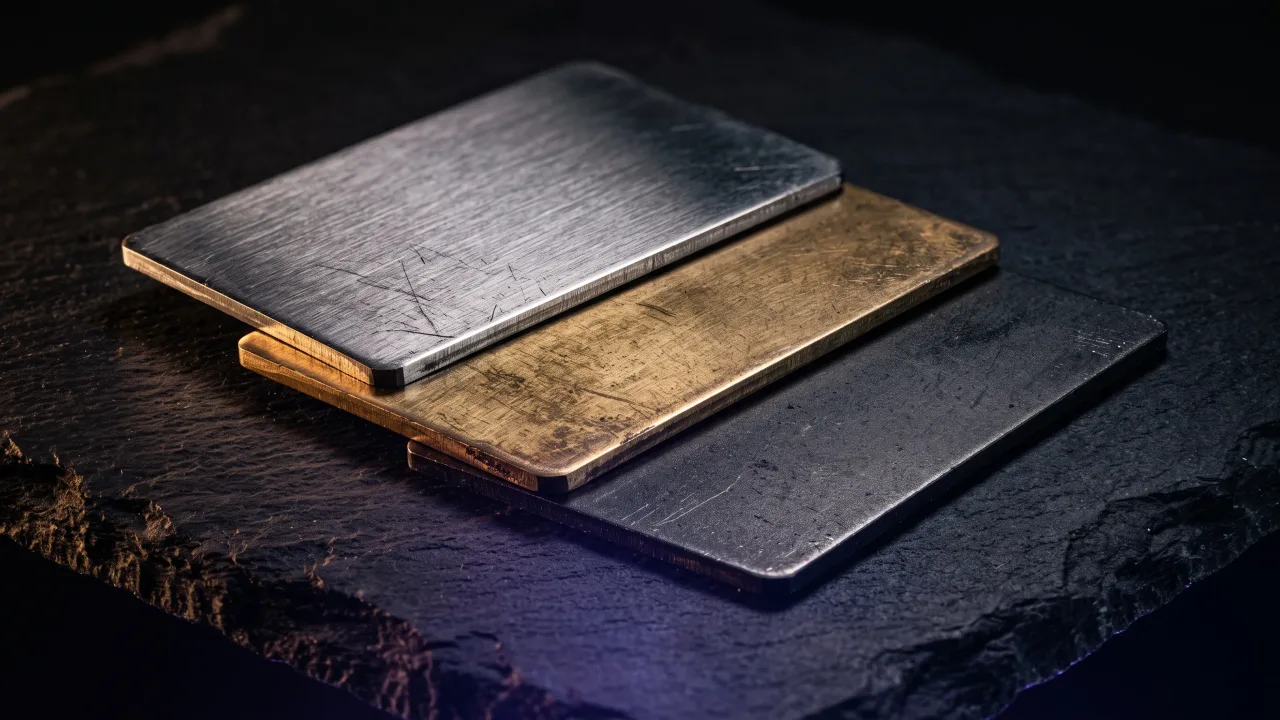
Stainless steel is a family rather than a single material, and the family disagrees about magnetism. Austenitic grades, the 300 series that includes the 304 used in most cards, are usually non-magnetic. Ferritic and martensitic grades, mostly the 400 series, are magnetic. What separates them is the arrangement of the atoms, not how much iron is in the mix. Wikipedia's rundown of the stainless steel families and their magnetic behaviour sets out which is which.
Card makers reach for 304 because it engraves cleanly, resists corrosion and takes a coating well. Being non-magnetic is a side effect of that choice, not a feature anyone was chasing.
There is one wrinkle worth knowing. Austenitic steel can pick up a little magnetism where it has been cut or work-hardened, because the crystal structure rearranges itself along the edge. A 304 card can give a faint tug at its rim and nothing at all across the face. If yours does that, the card is normal and so is the steel.
Which metals a magnet can actually pull
| Material | Responds to a magnet? | Why |
|---|---|---|
| Stainless steel 304 (austenitic) | Weakly or not at all | Austenitic structure; slight response near cut edges |
| Stainless steel 430 (ferritic) | Yes, clearly | Ferritic structure, the same family as a cheap kitchen pan |
| Brass | No | Copper and zinc, no ferromagnetic phase |
| Copper | No | Not ferromagnetic |
| Aluminium | No | Not ferromagnetic, whatever the anodised colour |
| PVD or powder-coated steel | Whatever the steel underneath does | The coating is cosmetic and has no magnetic effect |
| Wood and hybrid cards | No | No ferrous content in the body at all |
Read that column carefully. It answers whether a magnet can pull the material, which is a different question from whether the material can erase anything. None of the metals listed produce a field. Every one of our card materials sits somewhere in that table, and none of them has ever needed a warning label.
Magnetic business cards are a completely different product
Search this question and half the results sell you something else. Magnetic business cards are a flexible magnet sheet with a printed paper face laminated on top, roughly three layers thick, costing a few cents each. They belong on a fridge door. Steel has nothing to do with them.
The two products want opposite things. A magnet card wants to be parked on an appliance and forgotten until the pipe bursts. A metal card wants to be picked up, weighed in the hand and slipped into a wallet. Confusing them in a search result is easy. Confusing them in a buying decision is expensive, because you would be choosing between a reminder strategy and a first-impression one. If you are still working out which materials do what, our breakdown of what metal business cards are made of covers the alloys in more detail.
Will a metal business card wipe your credit card or hotel key?
No. The fear is reasonable in general and simply pointed at the wrong object here, and the numbers behind it are worth having.
Magnetic stripes are rated by coercivity, which measures how stubbornly they hold their data. Low-coercivity stripes sit around 300 oersteds and turn up on hotel keys, gift cards and transit passes. High-coercivity stripes, the ones banks use, sit nearer 2,750 to 4,000. The lab at K&J Magnetics ran the experiment properly and measured how close a neodymium magnet has to get to corrupt a stripe. Their strong disc magnet had to come within about a sixteenth of an inch. Their conservative advice for ordinary carry is an inch of separation for bank cards.
That is a magnet. Your business card is not one. A steel card brings no field to the pocket at all, so distance stops being a variable. Even a ferritic card, the kind that does grip a fridge, only responds to a field. It doesn't emit one.
Hotel keys are the genuinely fragile case at 300 oersteds, and they are also the ones increasingly being replaced by contactless RFID cards. Either way, the thing to keep away from them is a phone case magnet or a charging puck, not a piece of engraved steel.
If a stripe in your wallet has failed before, the culprit was probably closer to hand than you think. Magnetic clasps on folded wallets, the magnet ring in a phone grip, and cheap card sleeves with a snap closure all park a real magnet millimetres from the stripe for hours a day. That is the exposure profile the lab numbers describe. A metal card sitting in a separate slot is not.
What a magnet does to the NFC chip inside
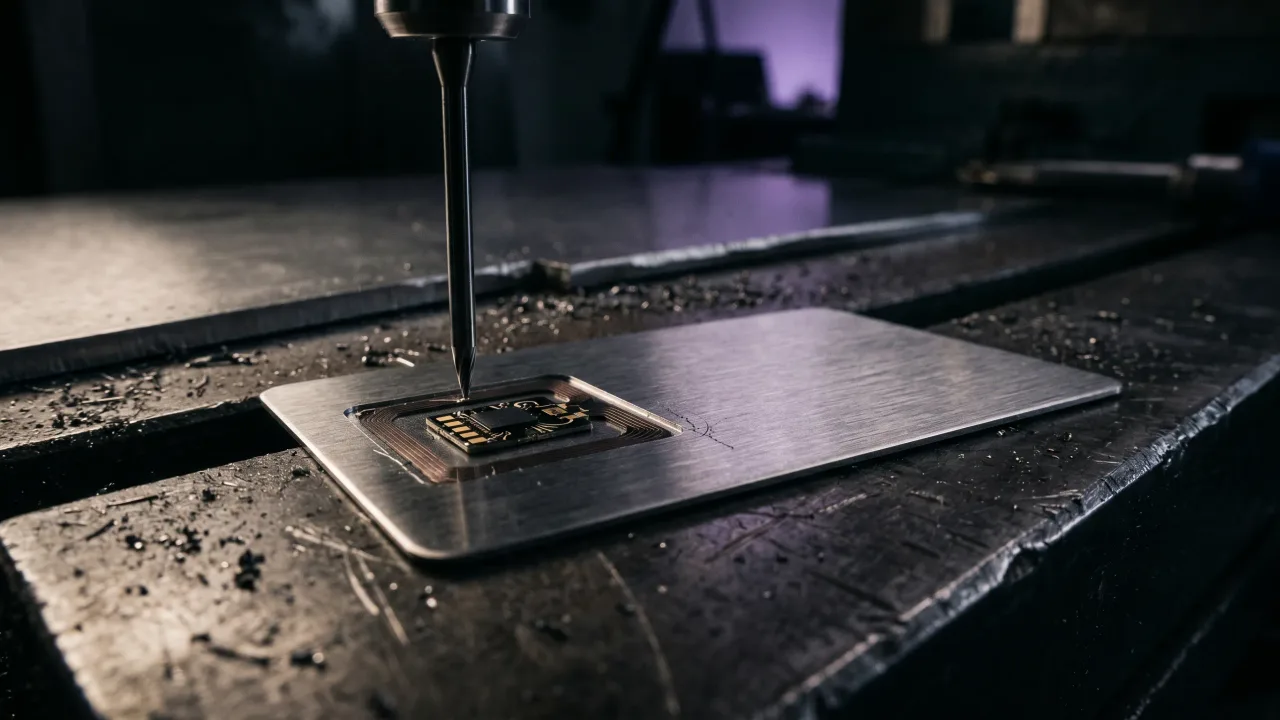
Nothing worth worrying about. An NFC card stores its data in an EEPROM chip, so there are no magnetic domains to scramble in the first place. The field that wakes the chip during a tap is an alternating radio field at 13.56 MHz, and a fridge magnet is static. They operate in different worlds.
Metal does interfere with NFC, but through a different mechanism entirely. The metal body induces eddy currents that detune the antenna, which is why a working metal card needs a ferrite layer between chip and body, or a non-conductive window cut into it. That engineering step is what separates a card that reads first time from one that reads sometimes, and we walked through it in how metal NFC business cards are made.
Magnets do get blamed for one real failure, though the mechanism is physical rather than magnetic. A magnetic phone grip or a thick MagSafe wallet sits directly over the phone's NFC antenna, and the metal in it blocks the read the same way a metal card body would. Take the grip off and the tap works. That is a phone problem wearing a magnet costume.
If a card has stopped reading, magnets are near the bottom of the list of suspects. Phone settings, a dead or cracked antenna and a badly built card sit far above them, which is the order we work through in our guide to an NFC business card that isn't working.
When you actually want a card to be magnetic
There is one honest case for a magnet card, and networking isn't it. The use case is repeat exposure. A plumber, a locksmith, an emergency dentist: these want to occupy a kitchen door until the moment of need, and a printed magnet does that job for pennies.
Metal cards work through the opposite mechanism. Nobody sticks one to a fridge. They end up on a desk, in a drawer of things too nice to throw out, or handed round a table because the weight makes people want to hold it. Adhesion keeps you visible. Weight makes you memorable. Pick the one that matches how your work actually arrives.
How to test the card in your hand in five seconds
- Touch a fridge magnet to the middle of the card face. No pull means austenitic steel, almost certainly 304.
- Try the edges next. A faint tug at the rim with nothing in the centre is work-hardening from the cut, not a different alloy.
- A firm grab anywhere means ferritic 400-series steel or plated mild steel underneath the finish. Not dangerous, just cheaper, and more likely to spot with rust over the years.
- Weigh it in your hand. A credit-card-sized blank at 0.8 mm in steel lands near 29 grams, which is roughly fifteen paper cards.
- Hold it near a bank card and stop worrying. There is no field to keep away from.
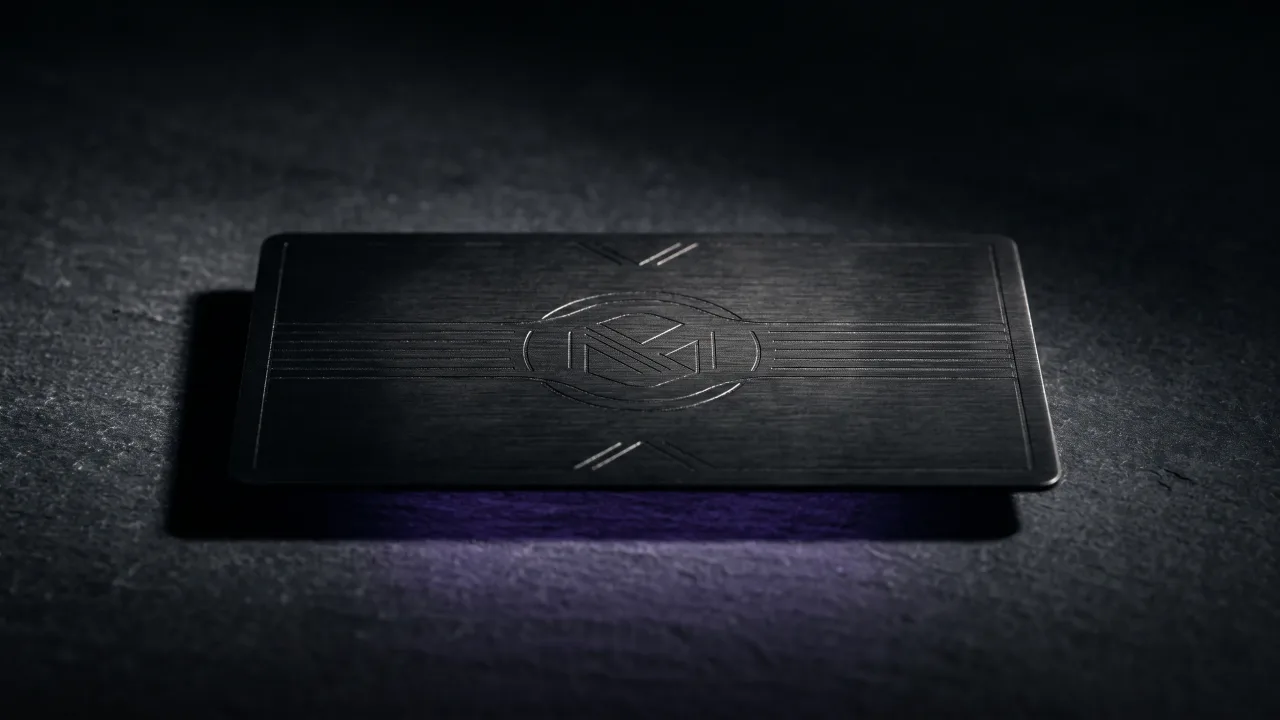
Our own cards are steel with an NXP chip inside the body, cut to standard CR80 credit-card dimensions so they live in a wallet without an argument. Run the magnet test on one when it arrives. It will fail, which is the correct outcome.
Are metal business cards magnetic? A minority technically are, almost none behave like it, and the answer changes nothing about how you carry one. Ask anyway, because the answer tells you what you bought. A card that clamps onto a fridge magnet is 400-series or plated mild steel, and that is a decision made on cost rather than on how the card ages. A card that ignores the magnet is 304, and 304 is what holds a crisp engraving and survives five years of pockets and handshakes. Buy for the engraving depth and for how the chip was mounted. The magnet test is just a free way to check whether the supplier told you the truth about the steel.
Pick a metal, put your name on it, and see the finished card before you spend anything.
Open the configuratorAre metal business cards magnetic?
Usually not. Most are made from 304 stainless steel, an austenitic grade that responds only weakly to a magnet, and brass, copper and aluminium cards do not respond at all. Cards made from 400-series steel do stick to a magnet, but they are the minority.
Will a metal business card demagnetize my credit card?
No. A metal card produces no magnetic field, so there is nothing to erase a stripe with. Erasing a bank card stripe takes a field in the thousands of gauss held almost against the surface, which is a strong neodymium magnet, not a piece of steel.
Do metal business cards stick to a fridge?
Standard 304 steel cards do not. Cards made from ferritic 400-series steel will hold on a fridge, and so will purpose-made magnetic business cards, which are a printed paper face on a flexible magnet sheet rather than metal at all.
Is 304 stainless steel magnetic?
Barely. Grade 304 is austenitic, so it is non-magnetic in its normal state. Cutting or bending it rearranges the crystal structure locally, which is why a card can show a faint magnetic pull along its edges and none across the face.
Can a magnet damage the NFC chip in a metal card?
No. NFC data lives in an EEPROM chip rather than on a magnetic surface, so a static magnet has nothing to act on. The 13.56 MHz field used during a tap is a radio field and works on a different principle entirely.
Why does my metal card stick slightly at the corners?
That is work-hardening from the cutting process. Austenitic steel becomes slightly magnetic where the crystal structure has been deformed, which happens along cut edges and corners. It says nothing bad about the card.
Will a metal business card set off airport security or shop alarms?
No. Shop gates respond to specific security tags, which a business card does not contain. Airport scanners image the card like any other object in a tray, and at under a millimetre thick it draws no attention.
What is the difference between a magnetic business card and a metal one?
A magnetic business card is a printed paper card laminated onto a flexible magnet sheet, designed to sit on a fridge. A metal business card is a solid sheet of steel, brass or aluminium, designed to be carried and handed over. They cost, feel and work nothing alike.