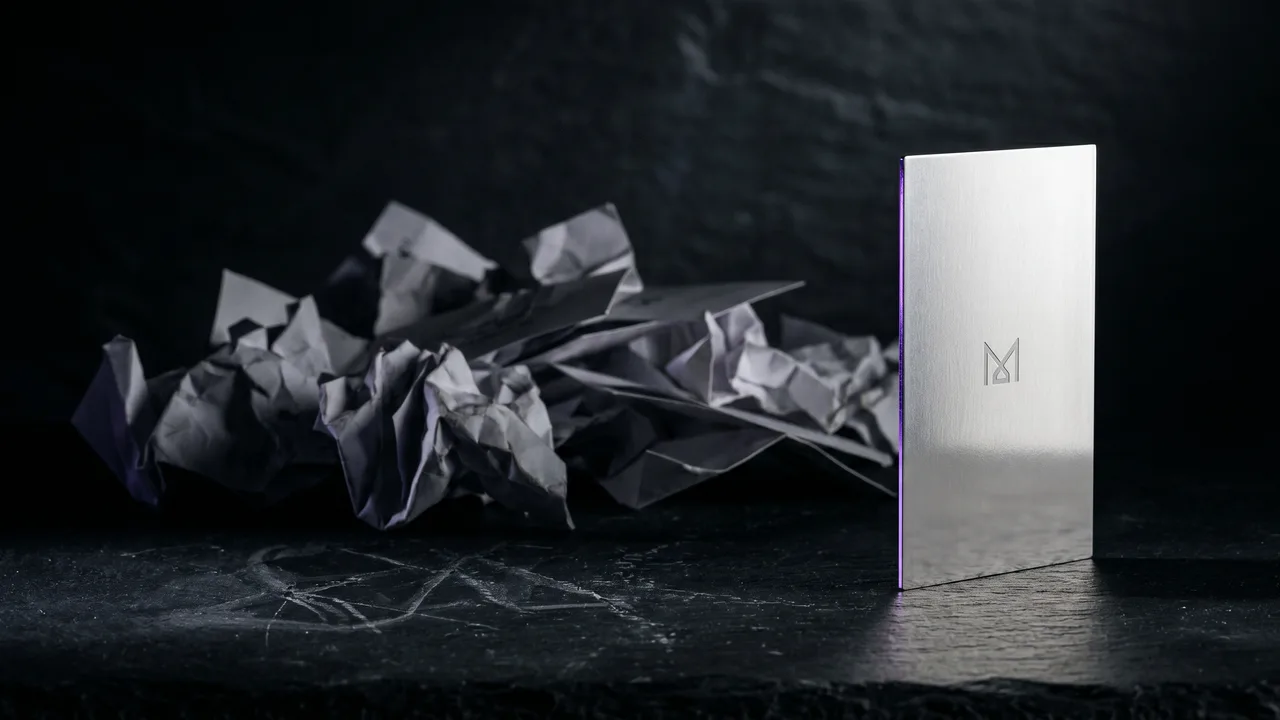
Ask three suppliers how much metal business cards cost and you get three answers an order of magnitude apart. €0.40 a card from the first. €6 a card from the second. €45 for a single card from the third. Nobody is lying. They are quoting three different objects.
Four things set the price: the metal, how the artwork gets onto it, how many you order, and whether there is a chip inside. Once you can see those four in a quote, the quote stops being mysterious. Below are the numbers suppliers publish and the ones they quietly add at checkout, plus what a finished card costs when you buy it as a product rather than a print run.
So how much do metal business cards cost?
In production quantities, metal business cards run from about €0.40 to €12 per card. Buy one or two as a finished product, with the engraving done and the chip already working, and the price sits between €25 and €50.
That spread covers real differences in the object. A 0.3 mm printed aluminium card at 500 units and a laser-engraved steel card at 25 units share a category name and very little else. The first is a printed sheet cut to size. The second is a machined piece of stainless steel, which costs more per sheet and refuses to bend in a pocket.
The figure quoted most often, €4 to €7 each, comes from one specific configuration: 100 laser-engraved cards in silver or black steel. Suppliers build their sample pricing around that tier, so it has quietly become the default answer to the question.
Metal business card prices by quantity
Unit price falls fast with volume because most of the cost at low quantities is setup rather than material. You pay for file prep and tooling once, then divide it across however many cards you ordered.
| Quantity | Price per card | Order total | What that price buys |
|---|---|---|---|
| 1–10 | €25–€50 | €25–€500 | A finished card, engraved, usually with NFC and a profile |
| 25–50 | €7–€12 | €175–€600 | Engraved steel or black metal, one design, one side |
| 100 | €4–€7 | €400–€700 | The standard quoted tier for engraved metal |
| 250–500 | €1–€3 | €250–€1,500 | Printed or shallow-etched aluminium, one design |
| 1,000+ | €0.40–€1 | €400–€1,000 | Thin printed aluminium, screen or UV print |
Read those as bands, not promises. Two suppliers quoting €5 a card at 100 units can be selling 0.5 mm and 0.8 mm stock, single-sided and double-sided engraving, or with and without a chip inside. Ask which before you compare.
What the metal itself costs you
Material is a smaller share of the price than most people expect, but it sets the floor. Aluminium is the cheap end, light and thin, and it is what nearly every sub-€1 card is made from. Steel costs more per sheet and gives a card the weight people comment on when they take it.
- Anodised aluminium at 0.3 to 0.5 mm is the budget substrate, and it is almost always printed rather than engraved.
- Stainless steel at 0.5 to 0.8 mm is the standard for engraved cards, and the reason a metal card feels like an object rather than a coupon.
- Black steel needs a coating or a PVD treatment, which is an extra finishing step and typically 10 to 20 per cent above bare steel.
- Brass and copper are priced above steel and patina with handling, which a few people want and most do not expect.
Thickness costs twice, once in material and once in slower cutting. A 0.8 mm card also will not slide into a wallet slot the way paper does, which is either the point or a problem depending on who you hand it to. Our own cards stay at CR80 credit-card size so they live in a wallet without an argument.
Printing, etching or laser engraving: what each method costs
Decoration is where two identical blanks end up €5 apart. Printing costs a plate and then almost nothing per card, while engraving costs machine time on every card that comes through, so the two methods diverge as the run gets shorter.
- Screen and UV printing are the cheapest, add full colour, and sit on the surface, so they can wear at the edges after years in a pocket.
- Chemical etching bites the design into the metal and fills it with colour. It costs more than printing and survives handling much better.
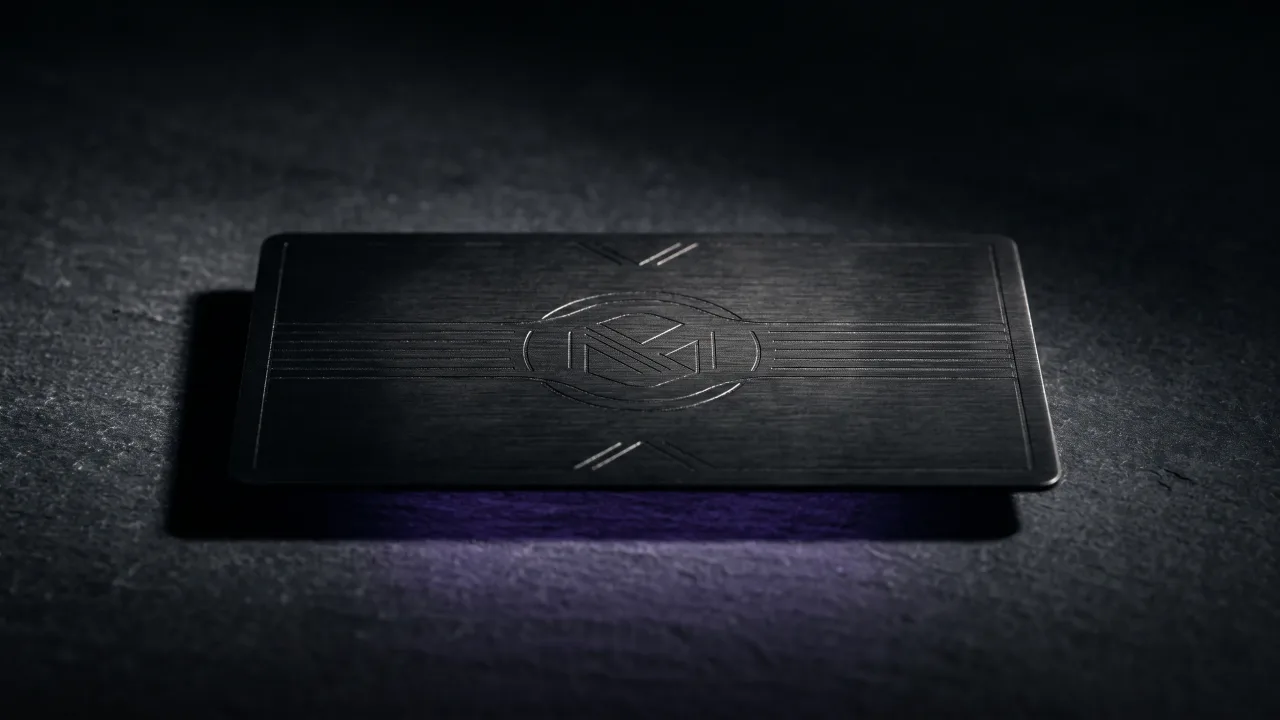
- Fibre-laser engraving uses no ink and no fill, because the laser alters the surface itself. It is the most expensive method at low volume and the only one that looks right on black metal.
- Cut-outs and hollowed shapes are priced per shape, and they slow a run down more than anything else here.
Colour is the trap. Metal wants one or two tones, and each extra colour fill is a separate pass with its own per-card charge and its own setup fee behind it. A design that reads well in a single tone costs less and usually looks better anyway. Our card configurator shows the engraving as you build, which is a faster way to test that than a supplier proof.
The line items nobody quotes upfront
The per-card figure in an advert is rarely what you pay. These are the additions that appear at checkout, or in the reply to your artwork email.
- Setup fee, €50 to €90 per side. Printing both sides doubles it, and a reorder months later can trigger it again.
- Artwork preparation, charged when your file is not vector-ready. Budget €20 to €60, or send clean vectors.
- Extra colour fills, a few cents per card per colour, each with its own setup.
- Samples, €10 to €40, sometimes credited against the order if you go ahead.
- Shipping and import charges. Cards made outside the EU arrive with VAT and a courier handling fee, which on a €300 order is not a rounding error.
- Reorders. Metal has no cheap top-up, so ten more cards next year can cost what fifty cost today on a per-card basis.
Add those to a €400 quote for 100 cards and the honest number lands nearer €500. That gap is the main reason single-card pricing and bulk pricing look impossible to compare.
Does NFC make a metal card more expensive?
Yes, and by less than people assume. The chip is cheap. An NXP NTAG 215, the standard for business cards, costs cents at volume. What costs money is putting it inside metal.
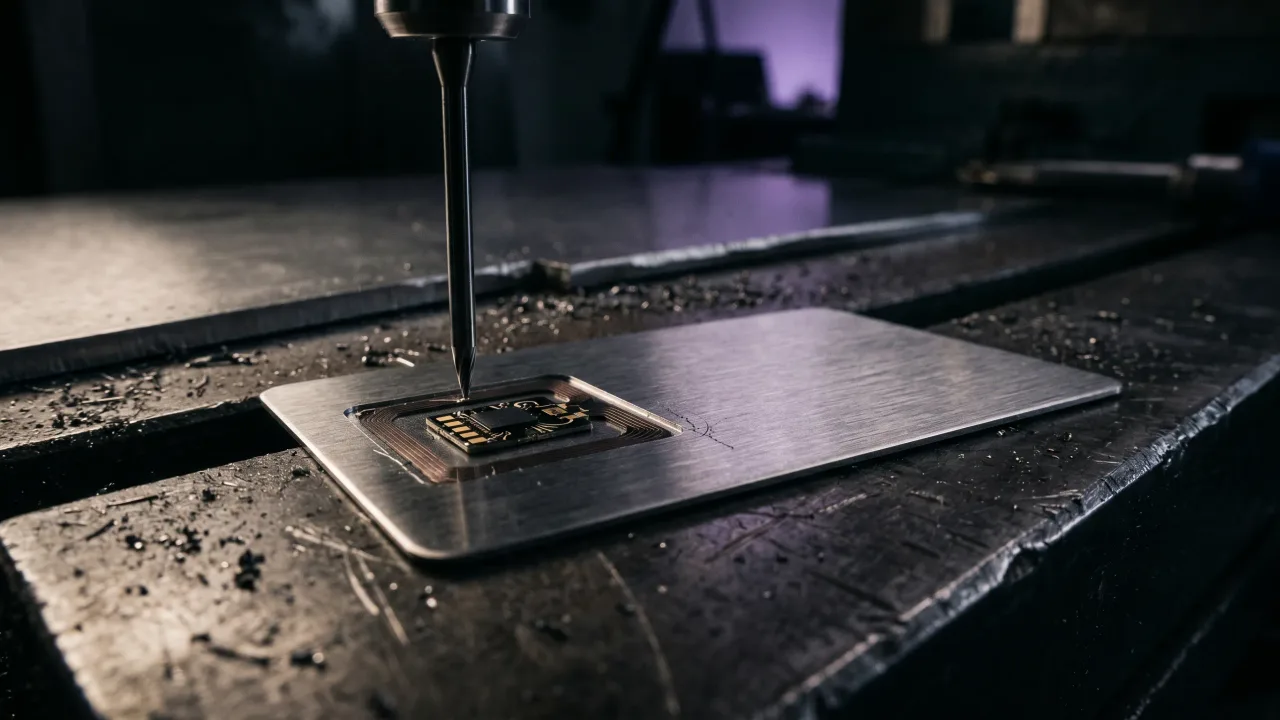
Metal blocks radio. A chip laid flat behind solid steel will not read at all, so the card has to be built around the antenna: a milled cavity, a slot, or two thin layers with the inlay sandwiched between them. That construction is why an NFC metal card sits above a plain one, usually by €3 to €8 a card in bulk, and why the cheapest NFC metal cards read on the second or third try. How metal NFC cards are made walks through the build.
The chip also changes what the money buys. A printed metal card is finished the day it ships. A card with near-field communication inside points at a digital profile you keep editing, so a new job title costs nothing instead of costing a reprint.
What a metal NFC business card costs at Discard
We price finished cards, not print runs, so the quantity game does not apply. A black, silver, gold or rose gold metal card with fibre-laser engraving, an NTAG 215 chip and a lifetime digital profile is €44.90. White metal is €49.90. Wood is €39.90. Logo engraving is included rather than billed as an extra.
There is no setup fee or per-colour charge, and no import VAT either, because the cards are made in Bulgaria. If you want the profile without a physical card, that is €19.90 on its own.
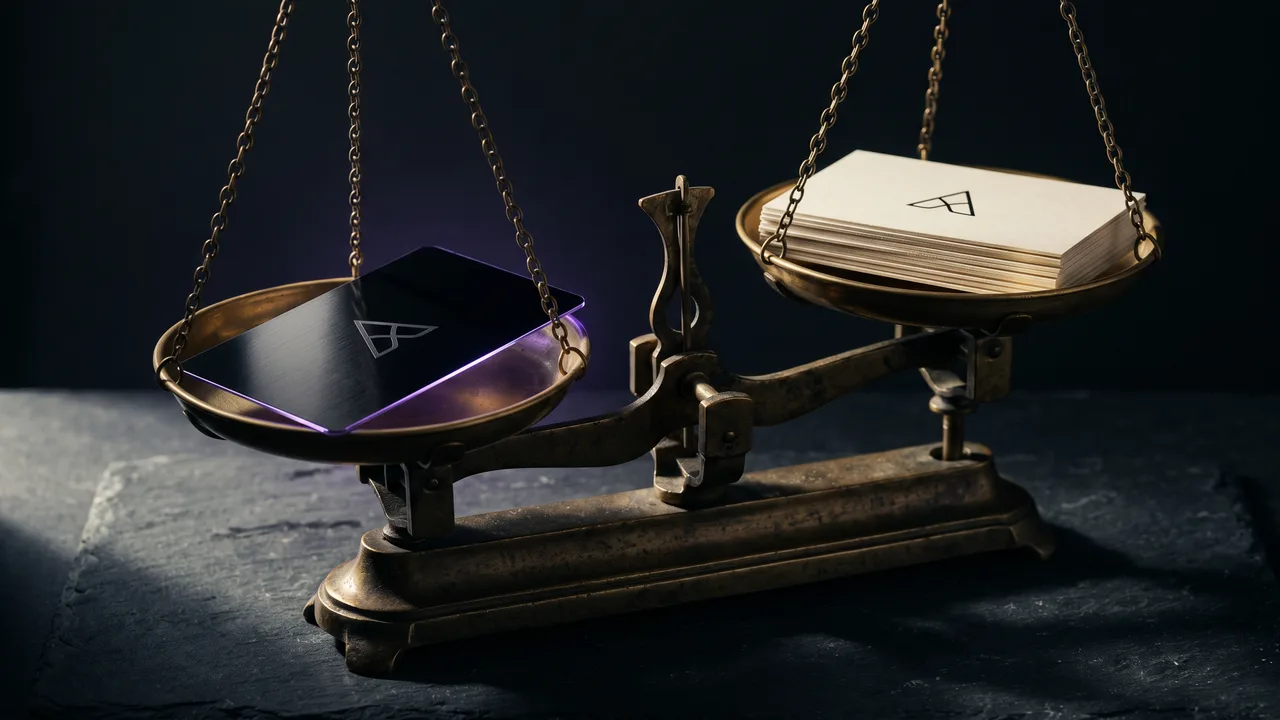
Set against the €4 to €7 bulk tier, €44.90 for one card reads as expensive until you count what you are buying. Bulk pricing assumes you will hand out five hundred cards. Most people hand out twenty a year, to people whose reply matters, and pay for four hundred and eighty that sit in a drawer. Teams are the exception, which is why bulk team pricing exists separately.
The verdict: what should you actually pay?
If you need five hundred cards to leave on a counter, metal is the wrong product and printed aluminium at €0.60 a card is the right one. Order it single-sided, in one colour, and stop reading here. If you hand cards to people whose reply matters, the per-card price stops being the number worth optimising. Twenty engraved cards at €7 each is €140 for a year of introductions, and you are paying for an object that outlives the meeting. The genuine waste is the middle of this market. A cheap metal card with a badly seated chip reads on the third try, its printed layer wears through in a year, and you have paid €12 to learn that metal only impresses when it is done properly. Buy the printed version honestly, or buy the engraved one properly. What you should not pay for is something trying to look like both.
See what a metal card costs with your name engraved on it. Pick the metal, set the layout, and watch the price as you build.
Price your cardFrequently asked questions
How much does one metal business card cost?
Between €25 and €50 for a finished single card with engraving and an NFC chip. Print shops rarely sell one at all, so single-card pricing comes from brands that sell cards as products rather than print jobs. Ours is €44.90 in black, silver, gold or rose gold.
How much do 100 metal business cards cost?
Roughly €400 to €700 for laser-engraved steel, which works out to €4 to €7 a card. Add the setup fee, usually €50 to €90 per side, and the real total lands nearer €500 even at the low end. Printed aluminium at the same quantity costs less than half that.
Why are metal business cards so expensive?
Because almost none of the cost is the metal. You are paying for setup, machine time on every single card, and a finish cut into the surface instead of printed on top of it. Adding NFC means the card has to be built around an antenna cavity, which adds another step.
What is the cheapest way to get metal business cards?
Order 500 or more printed aluminium cards, single-sided, in one colour, with vector artwork ready to send. That combination avoids the two largest costs, per-side setup and engraving time. Expect under €1 a card, and expect a printed surface rather than an engraved one.
Does laser engraving cost more than printing on metal?
Yes, per card, and the gap widens at low volume because engraving is machine time rather than a one-off plate. It also lasts longer, since the mark is a change in the metal rather than a layer sitting on it. On black metal, engraving is the only method that looks correct.
Are metal business cards cheaper if you order from overseas?
The quoted per-card price usually is. The landed price often is not, because import VAT adds 20 per cent in Bulgaria on top of a courier handling fee and three to four weeks of shipping. On small orders that erases most of the saving.
Are metal business cards worth the cost?
They are if you hand out tens of cards rather than hundreds, and if the person taking one is worth a second conversation. They are not if you need volume, or if your details change often and the card cannot be updated. A card pointing at an editable profile removes that second objection.