Zero. Every serious digital business card platform has a free tier, and for a freelancer with one job title it is genuinely enough. The sticker price is the least useful number in this whole subject. What matters is month fourteen, after the free tier grew a limit and the URL engraved on your card started belonging to somebody with a billing department.
So how much do digital business cards cost in practice? Somewhere between nothing and about €300 over three years. Both ends of that range are ordinary, and the gap between them has almost nothing to do with features.
The short answer on digital business card cost
Price splits into three layers that vendors like to blend together on a single pricing page.
The profile is software. A hosted page with your details on it, editable from a browser. Free at every major platform, roughly €€3 to €9 a month if you take the paid tier.
The card is hardware. A physical object with a chip in it, bought once. €10 for printed plastic, €€30 to €90 for engraved metal.
The third layer carries no price tag at all: what it costs you to leave. For most people it is the largest number of the three.
| Layer | Typical price | How it is billed | What you actually get |
|---|---|---|---|
| Hosted profile, free tier | €0 | Never | One profile, a QR code, provider branding on the page |
| Hosted profile, paid tier | €€3 to €9 a month | Monthly or annual | Custom domain, analytics, branding removed, lead capture |
| Team seats | €€4 to €7 per seat, per month | Annual, with a seat minimum | Admin console, shared templates, contact export |
| NFC card | €€10 to €90 | Once | The physical object people actually hold |
| Blank NFC tag, DIY | €€0.50 to €2 | Once | A chip you write a URL to yourself |
Those figures are August 2026 and they move. The bands have held for about three years though, so the shape is more useful than any single vendor's number.
What the free tiers actually give you
A free plan gets you one profile, your contact details, a handful of links, a QR code and a save to contacts button. That is the entire mechanism of a digital business card. Nothing in the paid tier makes the tap work better.
What you give up is the edges. Your page carries the provider's name at the bottom. The address sits on their domain, so it reads as a string of characters rather than your name. Analytics are absent, or reduced to one number that tells you nothing useful.
The limits arrive when you want a second profile for a second role, a custom domain, the branding gone, or a form that captures the other person's details back. Those are the four upsells, in roughly that order.
Read the word unlimited carefully while you are there. Unlimited taps is easy to offer, because a tap is a page load and page loads are close to free. Unlimited saved contacts is the promise that tends to come with an asterisk, and it is the one that matters if you work a trade show and collect two hundred leads in a weekend.
For plenty of people none of it is worth €70 a year. A designer with one email address and one portfolio link is fine on free indefinitely, and any vendor saying otherwise is selling something. How to make a digital business card for free walks through the setup.
What paid plans cost in 2026
Individual paid plans cluster between $$3 and $10 a month, which lands around €€3 to €9. Annual billing knocks 20 to 30 percent off, and vendors push it hard because it moves the cancel decision twelve months into the future.
Team pricing is per seat, between $$4 and $7 a month, usually with a minimum. Per seat is the number that bites. Twelve people on a €5 seat is €720 a year, every year, for a page that could have been static HTML.
A sizeable group of vendors publish no prices above the individual tier at all. Book a demo, get a quote. Invisible pricing means negotiable pricing, and negotiable means somebody is paying more than you for the same thing.
Read the renewal terms rather than the headline rate. Annual plans that renew at a higher second year price are common enough across software that the checkout page deserves a second look before you commit.
There is one honest reason to pay monthly, and it is sales. If the card feeds a CRM, and a captured lead is worth a few hundred euro to you, then €9 a month is rounding error. Everyone else is buying a page that a free tier would have hosted just as well.
What the NFC card itself adds
The chip is the cheapest thing on this page. An NTAG215 tag costs a few cents at volume, and the specification it implements, published by the NFC Forum, has been stable for over a decade. Nobody is charging you for silicon.
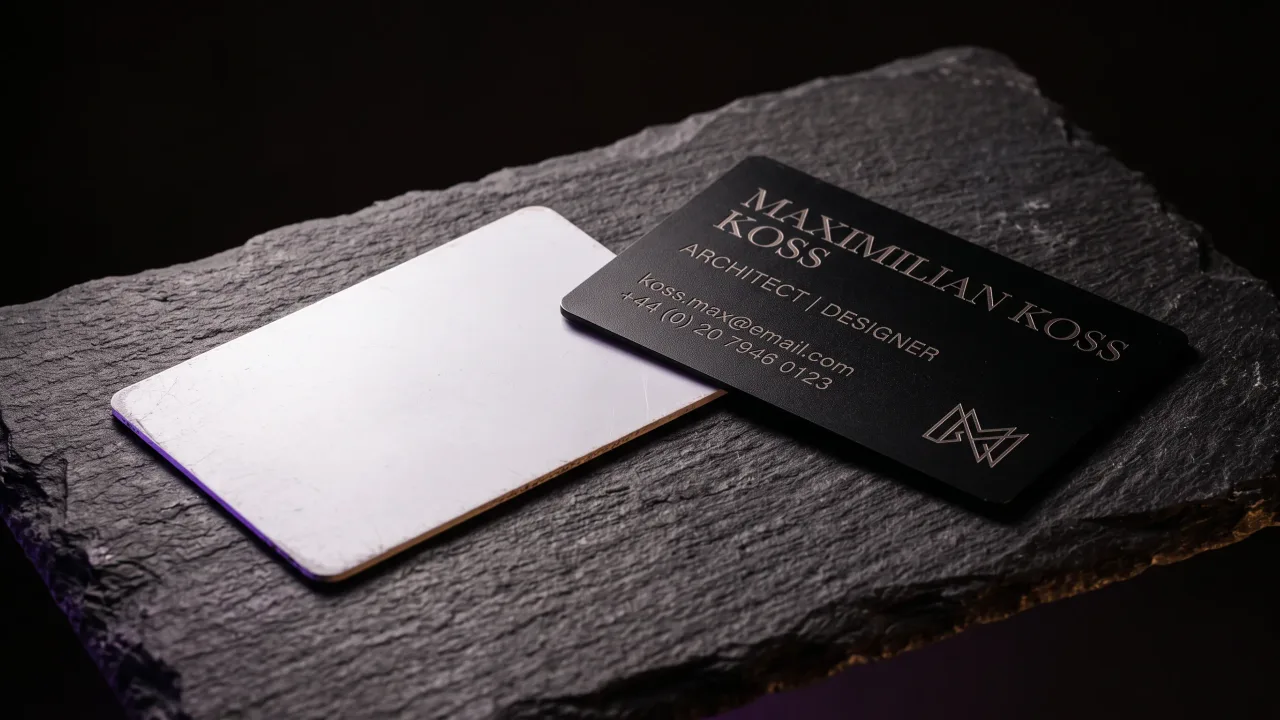
You are paying for the object. Printed plastic runs €€10 to €25. Stainless steel, black metal or bamboo, engraved rather than printed, runs €€30 to €90 depending on finish and quantity. What metal business cards cost breaks that down by material and method.
Blank programmable tags are the floor. A pack of NTAG215 cards works out at about a euro each, you write a URL to them with a free phone app, and you are finished in ten minutes. They look like what they are, which is the point for some people and the whole problem for others.
Quantity moves the metal price more than anything else. Engraving is a setup cost, so ten identical cards cost far less each than one, and a hundred less again. Where the design changes per person, which it does for a team, the setup runs once per card and the discount mostly disappears.
One thing worth checking before buying any card: whether the hardware is tied to the subscription. If cancelling the plan makes the card stop working, you were renting it. NFC business cards without a subscription covers how to tell the difference.
The costs that never appear on the pricing page
West Monroe polled 2,500 consumers about subscription spending and found the real average at $273 a month, with 66 percent of people underestimating their own total by more than $200. A €7 line item is engineered to sit below that radar, and it works.
The bigger exposure is the address. Your card points at a domain you do not own. If the provider raises prices, gets acquired or closes, the object sitting in somebody's wallet becomes a dead link, and no reprint fixes a card you handed out two years ago.
Exporting matters as much. Ask before you commit whether you can pull saved contacts out as a CSV, and whether the profile can be pointed at a domain you control. A vendor that answers yes twice has just capped your switching cost.
Accountants call this total cost of ownership, and the definition is blunt: ownership costs run well past the purchase price. A business card is a three to five year object. Price it over that window, not over the checkout screen.
Three years, one spreadsheet
Same person, same networking habit, five different decisions. Rounded numbers, one card, no team seats.
| Approach | Year one | Years two and three | Three year total |
|---|---|---|---|
| Paper cards, reprinted twice a year | €80 | €160 | €240 |
| Free digital profile, no card | €0 | €0 | €0 |
| Free profile plus a blank NFC tag | €2 | €0 | €2 |
| Subscription platform at €7 a month plus a €40 card | €124 | €168 | €292 |
| One time metal card plus a €19.90 yearly profile | €44.90 | €39.80 | €84.70 |
The free row wins on money and always will. It loses on the thing no spreadsheet has a column for, which is that a QR code in an email signature cannot be handed to anybody. Our breakdown of what paper cards really cost has the reprint maths behind the first row.
The distance between rows four and five is €207 over three years. That is what monthly billing costs you, for the same page, opened by the same tap.
What Discard costs, so you can compare
Disclosure before the numbers: we manufacture metal NFC cards, so read this section knowing who wrote it.
The card is €€39.90 to €49.90 depending on material, paid once. That price includes the first year of the digital profile. After that the profile is €19.90 a year. There is no monthly tier, no per seat charge for an individual, and no feature held back for a higher plan.
Cancel and the card carries on being an engraved card with your name on it. The profile is the part that lapses. You can see how engraving falls on each material in the card configurator, and what the page itself does on the digital profile page.
Teams are quoted per order rather than per seat per month, which is a different shape from most of this market. Bulk orders has the details.
Start free. Set up a profile on a free tier, use it for a month, and find out whether you hand out contact details often enough for any of this to matter. Plenty of people discover they do not, and that is a €300 answer for nothing. If you do, pay for the object rather than the software. A good card is bought once and lasts as long as your name does, while a subscription is a bet that a company you have never met stays solvent and keeps its prices flat. Where a recurring fee is unavoidable, keep it annual and keep it small, and make sure you can point the card at your own domain if the relationship ends. Whichever way you go, work out first how hard it would be to leave. That number is on nobody's pricing page and it is the one that decides whether any of this was cheap.
Price a metal card with the first year of the digital profile included.
Design your cardHow much do digital business cards cost?
Between nothing and about €300 over three years. Every major platform has a free tier that covers the basics, paid individual plans run roughly €€3 to €9 a month, and a physical NFC card is a one time €€10 to €90 on top. What you end up paying depends far more on the billing model than on the features.
Are digital business cards free?
The software part is. Free tiers give you one profile, your details, links, a QR code and a save to contacts button, which is the entire mechanism. You start paying when you want a custom domain, the provider's branding removed, real analytics, or a lead capture form.
How much does a digital business card cost per month?
Paid individual plans sit between $$3 and $10 a month, roughly €€3 to €9. Annual billing usually cuts 20 to 30 percent off that. Check what the plan renews at in year two, because the first year rate is often promotional.
How much do digital business cards cost for a team?
Team plans are priced per seat, around $$4 to $7 per person per month, and most carry a seat minimum. Twelve seats at €5 is €720 a year. Some vendors quote teams per order instead, which is worth asking about before signing anything monthly.
How much does an NFC business card cost?
Blank programmable NFC tags cost about a euro each. Printed plastic cards run €€10 to €25, and engraved metal cards €€30 to €90 depending on the material and the quantity. The chip inside is worth a few cents in all three cases, so you are paying for the object.
Do you have to pay a subscription for a digital business card?
No. You can write your own URL to a blank NFC tag and host the page anywhere, including for free. A subscription buys hosting and the ability to edit the page without touching the card. Check whether the card keeps working after you cancel, because with some vendors it does not.
Are digital business cards cheaper than paper?
Over three years, usually. Reprinting paper twice a year costs around €240 in that window, while a one time card with an annual profile fee lands nearer €85. A free profile with no card costs nothing at all, though it gives up the physical handoff entirely.