One person with a digital business card has a link. Forty people with digital business cards have a small internal project. Nobody mentions that part in the demo.
Digital business cards for teams get sold on the easy half: everyone gets a profile, everyone shares it with a tap, the details are always current. The awkward half arrives later, when somebody leaves with a live company profile, somebody else swaps the logo for a photo of their dog, and finance asks why the invoice renews every month.
The part of the rollout that actually costs time is below, along with how to plan around it. We make metal cards with hosted profiles and we run team orders, so you know where our interest lies. Most of it applies whatever you end up buying.
What changes when the card belongs to the company
A personal card answers to one person's taste. A company card is an asset with a lifecycle: it gets issued, it gets maintained, and at some point it has to be switched off.
That shifts three things out of the individual's hands and into somebody's job description. The look of the card and the profile. The contact data that moves through it. And the ability to revoke the whole thing later.
The worst failure of a personal card is an old phone number. The worst failure of a company card is a former employee still handing out a live profile with your logo on it, six months after they left. Those are different problems, and only the second one needs a policy.
Most of the pain in a team rollout traces back to buying the first kind of product to solve the second kind of problem. Digital business cards for companies and digital business cards for individuals look identical on a pricing page. They are not the same purchase.
Somebody also ends up owning this permanently, as a small piece of administration that never finishes. Usually it lands on marketing, sometimes on office management, occasionally on IT. Pick the person before the cards, because an unowned system decays into forty personal accounts within a year.
Brand control is the problem nobody predicts
Give forty people a profile editor and you get forty interpretations of the brand. The logo gets stretched. The company blue drifts two shades. Somebody centres their job title and somebody else writes theirs in lowercase because it looks calmer.
None of that is malice. It is what happens when a design system meets an open text field, and it is how a rollout stops being used, about four months in, without anyone announcing it.
The fix is deciding, before anyone gets an account, which fields a person may change and which are fixed. A workable split looks like this: name, role, direct phone, photo and personal links belong to the individual; logo, colours, layout, company name and the card itself belong to the company.
Our team orders take that line by default. The order picks one card layout and one profile style for the whole batch, brand assets get uploaded once, and each person's details come from a spreadsheet rather than from each person. If you want to see the layouts before committing, they are all in the configurator, which uses the same renderer we use for team cards.
Who owns the contacts your team collects
Data flows two ways through a digital business card, and the two directions carry very different obligations.
The first direction is outward. Someone taps your card, opens your profile and saves your details to their phone, usually as a vCard, the contact file format defined by the IETF. Nothing about that needs a legal review. You published your work number on purpose.
The second direction is inward, and it is where team platforms differ sharply. Many of them offer lead capture: a form on the profile that collects the other person's name, email and phone into a database for your sales team. That database is personal data, and under the General Data Protection Regulation your company needs a lawful basis to hold it and a way to delete it on request.
Three questions are worth asking any vendor before the first invoice. Can we export everything in a standard format? If we stop paying, what happens to the records? Who else can read them?
CRM integration deserves its own scepticism. Every team plan advertises it, and what it means in practice ranges from a proper two-way sync with Salesforce or HubSpot down to a nightly CSV you import by hand. Ask which objects get created, what happens on a duplicate, and whether the integration survives the vendor's next pricing change. A sales team that has to clean up after an integration will stop using the cards faster than one that never had an integration at all.
Our answer is a narrow one. Discard profiles count taps, opens and saved contacts, and they do not collect the visitor's details. There is no lead database, which means there is nothing for us to lose and nothing for you to justify to a data protection officer. Teams that genuinely need lead capture at the event stand should buy a tool built for that and keep it separate from the cards.
Joiners, movers and leavers
Identity people have a name for the three events that break company accounts. The UK's National Cyber Security Centre calls it a joiners, movers and leavers process, and it applies to a business card profile as much as to an email account.
A joiner needs a card and a working profile within days, not at the next bulk order in March. Ask how a single extra card gets added to an existing batch, and what it costs, because that answer decides whether new starters get a card at all.
A mover is the case digital cards genuinely solve. Someone gets promoted, their title changes, the profile updates, and no box of paper gets thrown away. This is the strongest argument for putting a profile behind the card in the first place.
A leaver is the case to test before you buy. You are not getting the metal back, so the only thing that matters is the destination. You need to be able to disable the profile, or point the chip at something else, on the day they leave. Ask how long that takes and who can do it. If the answer involves emailing support, that is your answer.
Write the rule down before the cards arrive rather than during the first resignation. Ours is simple: a team profile belongs to the company that ordered it, not to the person named on it, and we disable or repoint it when the company asks.
Offboarding is also where physical-only orders make sense. Some companies order the cards with no profiles at all and point each chip at a URL they already run, an internal page or a personal LinkedIn. It moves the whole lifecycle problem onto systems they control. We support that as an option on team orders, and it suits organisations with an IT department that would rather not add another vendor to the list.
Per-seat subscriptions versus a one-time card
Most digital business card platforms bill per user per month, with team features on the higher tiers. That model is fine when the software does continuous work. A card that shows your name and opens a page does not do continuous work.
The arithmetic is worth doing once, on paper, before anybody signs. Take the per-user monthly price you have been quoted. Multiply by headcount. Multiply by twelve. Then by three, because three years is roughly how long a team keeps a system before reviewing it. Now compare that number against buying the hardware once.
For context, our team pricing is €38.00 per card for 10 to 49 cards and €34.00 per card for 50 to 199, both excluding VAT, with the digital profile included and no per-seat monthly fee. Forty cards is €1,520 once. Whether that beats a subscription depends entirely on the monthly figure in front of you, which is why the arithmetic matters more than our opinion of it.
Two caveats, honestly. A subscription buys ongoing development, and it is easier to cancel than to unbuy forty pieces of steel. A one-time purchase buys certainty and a predictable line in next year's budget. We went into the trade-off properly in NFC business cards without a subscription and broke down the market's pricing models in how much digital business cards cost.
Getting the data in, and the first Monday
The bottleneck in a team rollout is never the hardware. It is the spreadsheet.
Forty people means forty names, roles, phone numbers, email addresses and possibly forty photos, all consistent enough to print. Collecting that by email takes two weeks and produces four people called "Senior Manager", two called "senior manager" and one who sent a holiday snap.
Decide these before you send the request:
- One owner for the spreadsheet. Not a shared inbox, a person.
- Agreed wording for job titles, written as a short list people pick from.
- One phone format, with the country code, for everybody.
- Photos in or out. Decide once. Half a team with portraits and half without looks worse than neither.
- Which links go on every profile (website, careers page, booking link) and which are personal.
- Who checks the spelling of names before the file goes to production. Engraving is not reversible.
Our team wizard takes a CSV or XLSX file, shows you the parsed rows before you submit, and ships a template so the columns match. Larger organisations on the enterprise tier can go further and sync from a directory rather than a file, which is the right answer once headcount changes weekly.
Then there is the first Monday, when the cards land. Hand them out at one meeting rather than leaving them in pigeonholes, and demonstrate the tap once on an iPhone and once on an Android. Two minutes of demonstration prevents the thing where half the team assumes their card is broken because they held it against the wrong end of the phone.
What team analytics actually tell you
Team plans, ours included, report taps, profile opens and saved contacts per person. That data is useful and routinely misread.
A tap is a phone opening a page. A save is a person deciding to keep you. The second number is the one that means anything, and it is usually far smaller than the first, which comes as a shock to anyone who has been quoting tap counts in a board deck.
Use the numbers to compare events rather than people. The trade fair that produced sixty saved contacts and the one that produced four are telling you something about your marketing budget. A league table of colleagues is telling you who works the room, which you already knew, and it turns the card into a metric people game.
A box of paper cards, for comparison, tells you how many are left in the box.
How to roll out to ten, fifty or two hundred people
This sequence goes wrong least often. It assumes a few weeks, not a few days.
- Decide who gets a card first. The people who meet customers earn theirs; everybody else waits for round two.
- Lock the template and the brand assets before collecting any personal data.
- Order one sample card and hold it in your hand. Engraving reads differently in metal than it does on a screen, and this is the cheapest moment to change your mind.
- Collect the spreadsheet, with one owner and the rules above.
- Write the leaver rule into the handbook while you wait for production.
- Distribute in person, in one meeting, with a live demonstration.
- Review after a quarter using saved contacts, then order round two.
Two hundred cards is a different exercise from twenty. At that size the questions become directory sync, a named contact on the supplier side, and a documented process for the joiner in week three. That is what our enterprise tier exists to cover, and it is worth a conversation before you pick a format.
Where the physical card still fits
A digital profile with no object attached is a link somebody has to type, or a QR code on a phone screen you are asking a stranger to photograph. Both work. Neither is memorable, and neither survives the moment the conversation ends.
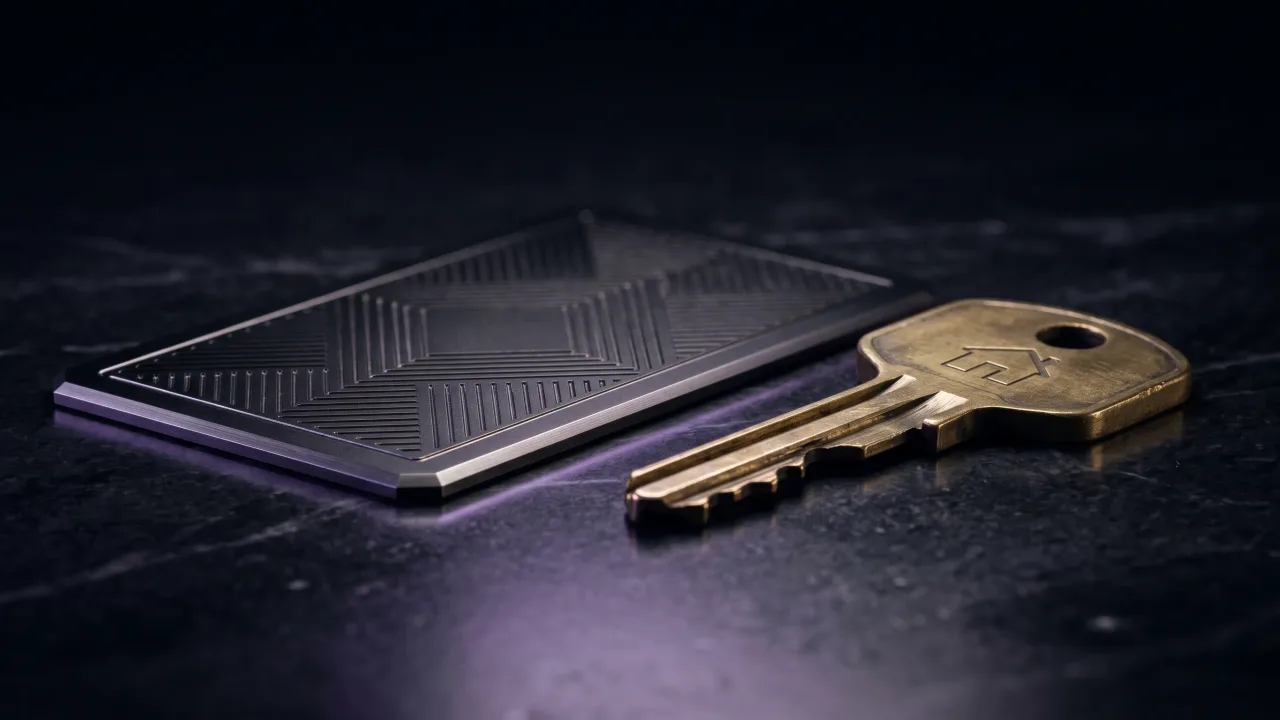
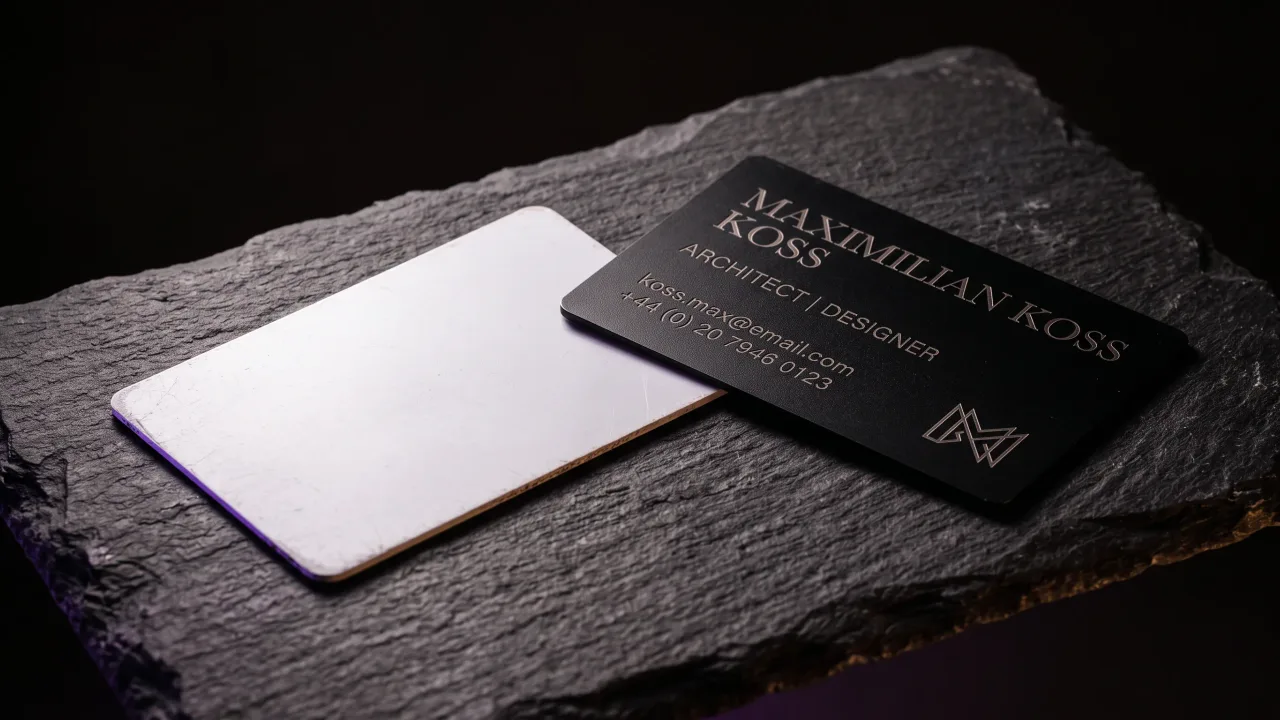
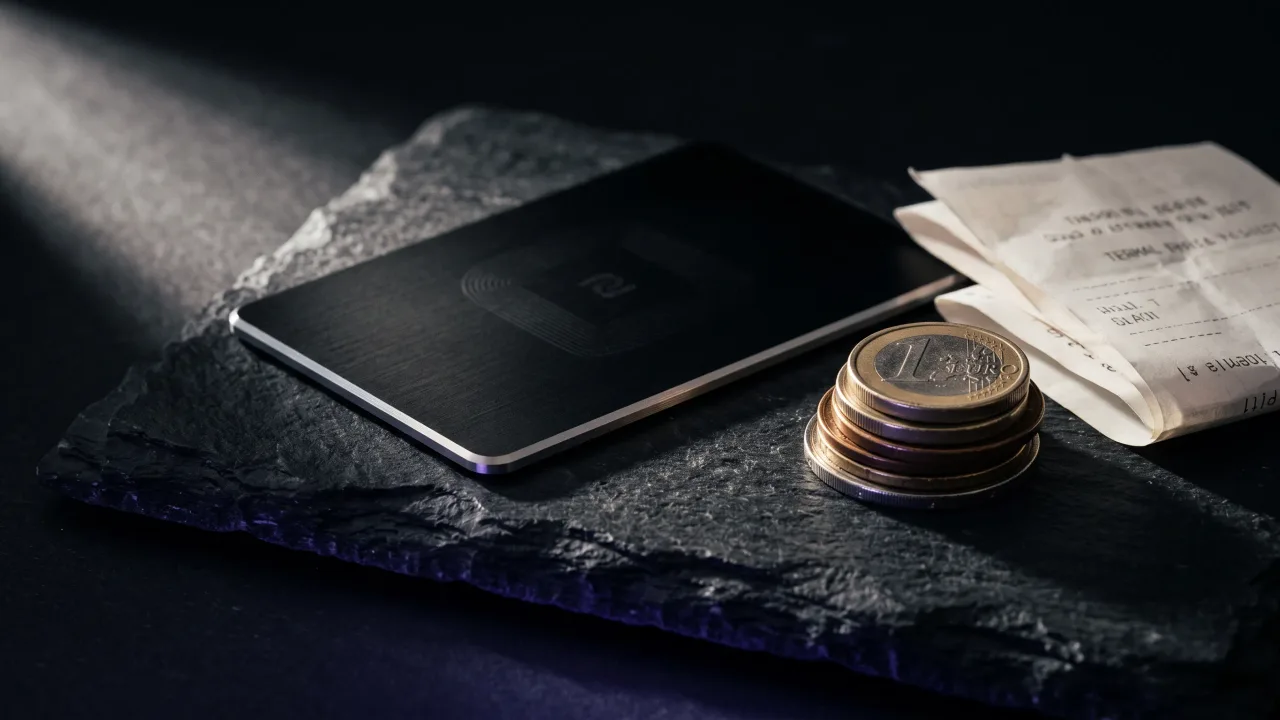
The physical card is the delivery mechanism. Our steel cards are 0.8 mm thick, weigh 25 to 30 g and are standard CR80 size, 85.6 by 54 mm, so they sit in a wallet next to a bank card. They carry an NFC chip and a QR code, because the phone across the table decides which one it prefers and you do not get a vote.
This matters more for a team than for one person, because a team meets a wider spread of phones than any individual does. Built-in contact sharing only works between devices from the same manufacturer, so in a mixed room it simply does nothing for half the people present. A chip that opens a web page works with whatever the other side is carrying, which is why digital business cards for employees still come attached to an object.
What the chip opens is the part that makes it a team product rather than forty souvenirs. Every card points at a digital profile your company controls, can update when a title changes and can switch off when someone leaves. The metal is the reason it gets kept. The profile is the reason it stays correct.
Digital business cards work well for teams, and the thing that decides whether a rollout survives its first year has almost nothing to do with the cards. It is whether somebody owns the template, the spreadsheet and the offboarding rule. Get those three right and the technology is uneventful. Get them wrong and you have forty inconsistent profiles, an ex-colleague still handing out your logo, and a subscription nobody can remember approving. Our bias is obvious: we think the profile should be included rather than rented, and the object should be heavy enough that people keep it. But the honest advice is to test the leaver case with any vendor you are considering, before the invoice rather than after it.
Metal cards for the whole team, one brand template, individual profiles your admins control. Volume pricing from ten cards.
Start a team orderWhat is a digital business card for teams?
It is a company-wide version of a digital business card, where every employee gets their own profile under one brand template and an administrator controls the lot. The individual fills in their name, role and contact details. The company keeps the logo, colours and layout fixed.
What happens to a digital business card when an employee leaves?
That depends on the supplier, which is why it is the first thing to ask about. On a team plan an admin should be able to disable or reassign the profile on the day of departure, so the chip stops opening a live page with your branding on it. You will not get the physical card back, so the destination is what matters.
Do digital business cards for teams require a subscription?
Most platforms bill per user per month, but it is not a technical requirement. Our team cards are a one-time purchase with the digital profile included and no per-seat monthly fee. Compare the three-year total of any per-seat quote against the hardware cost before deciding.
How do you keep branding consistent across a whole team?
Lock the fields that belong to the company and leave the rest open. Logo, colours, card layout and company name should be fixed at the order level; name, role, phone and photo are per person. Ordering as one batch rather than letting people order individually does most of the work.
How much do digital business cards cost for a team?
Our volume pricing is €38.00 per card for 10 to 49 cards and €34.00 per card for 50 to 199, excluding VAT, with the profile included. Above 200 cards it is quoted individually. Subscription platforms price per user per month instead, so the comparison depends on how long you plan to keep the system.
How do you send everyone's details for a bulk order?
As one spreadsheet. Our order wizard accepts CSV or XLSX, maps the columns for you and shows the parsed rows before you submit, and we publish a template so the headings match. Agree job titles and phone formats before you circulate it, because engraved mistakes are not editable.
Can you see how the team uses the cards?
Yes. Team plans report taps, profile opens and saved contacts for each profile. Read saved contacts as the real number and use it to compare events rather than colleagues, since tap counts flatter anyone who hands their card to the same person twice.