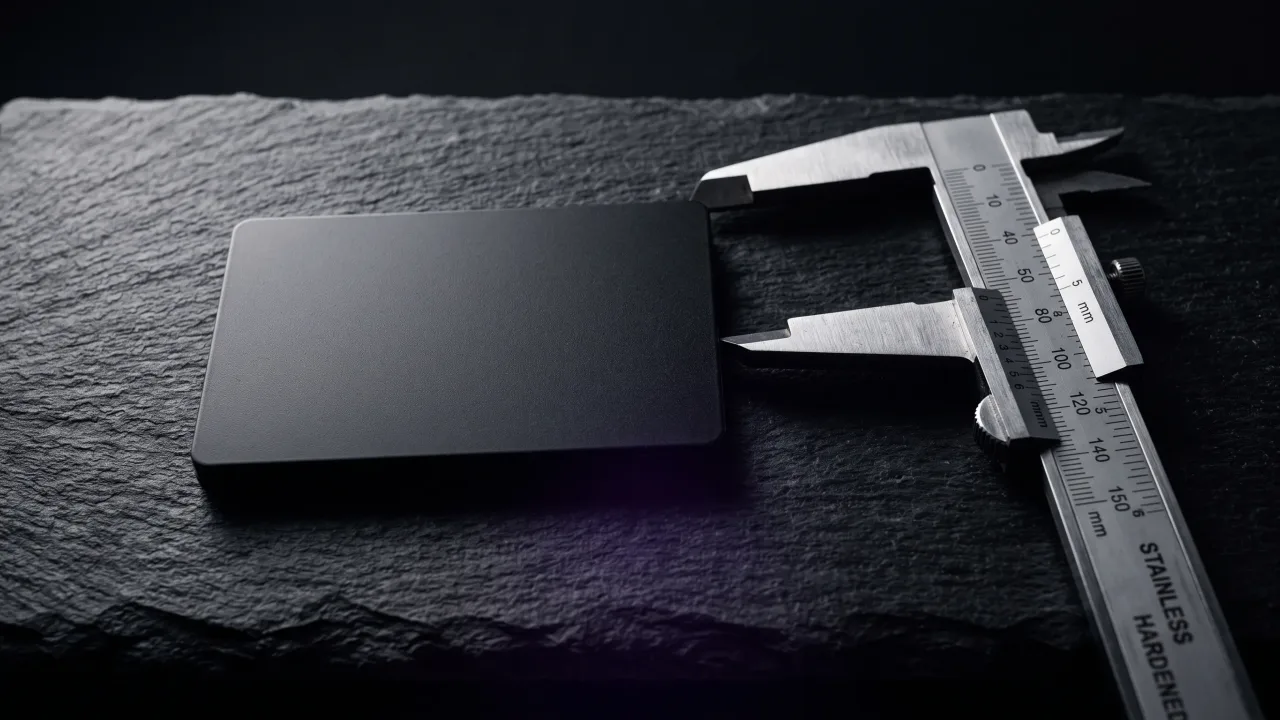
Wallet slots were cut for bank cards. Nobody asked the print industry for an opinion. That single accident of history is why metal business cards are 85.6 x 54 mm, the same footprint as the card already sitting in the slot next to it.
Paper forgives a bad size, because paper bends. Metal does not. A steel card that misses the slot by two millimetres ends up on a desk, then in a drawer, then nowhere. Size decides whether the card travels.
The short answer: 85.6 x 54 mm
Almost every metal card worth buying is cut to CR80, the ID-1 format defined in ISO/IEC 7810. The spec says 85.60 x 53.98 mm with a corner radius between 2.88 and 3.48 mm. Everyone rounds it to 85.6 x 54 mm.
The same standard sets thickness at 760 micrometres with an 80 micrometre tolerance, so anything from 0.68 to 0.84 mm counts as ID-1. Our steel cards sit at 0.8 mm, near the top of that band, against the 0.5 mm most makers ship. The wood composite version runs thicker at 1.2 mm, because timber needs more section to stay rigid.
CR80 is not the only size on the market. Plenty of American makers work to 3.5 x 2 inches, the paper convention, which is 3 mm wider and 3 mm shorter. It looks close enough on a screen and does not go into a card slot.
| Format | Dimensions | Fits a wallet slot | Where you see it |
|---|---|---|---|
| CR80 / ID-1 | 85.6 x 54 mm (3.37 x 2.13 in) | Yes | Bank cards, hotel keys, most metal cards |
| US paper standard | 88.9 x 50.8 mm (3.5 x 2 in) | No, too wide | Printed cards in the US and Canada |
| European paper standard | 85 x 55 mm | Tight | Printed cards across Western Europe |
| Japanese meishi | 91 x 55 mm | No | Formal exchange, carried in a case |
| Slim and custom cuts | Varies | Depends | Novelty shapes, bottle openers, keyrings |
Why metal cards use the credit card format
The wallet argument does most of the work. A card that lives in the same slot as a bank card gets carried for years. A card that has to go in a jacket pocket gets carried until laundry day.
Manufacturing pushes the same way. Steel is cut and held on fixtures built around a standard blank, so a bespoke outline means paying for tooling before you pay for cards. Our breakdown of what metal cards cost shows where that money goes.
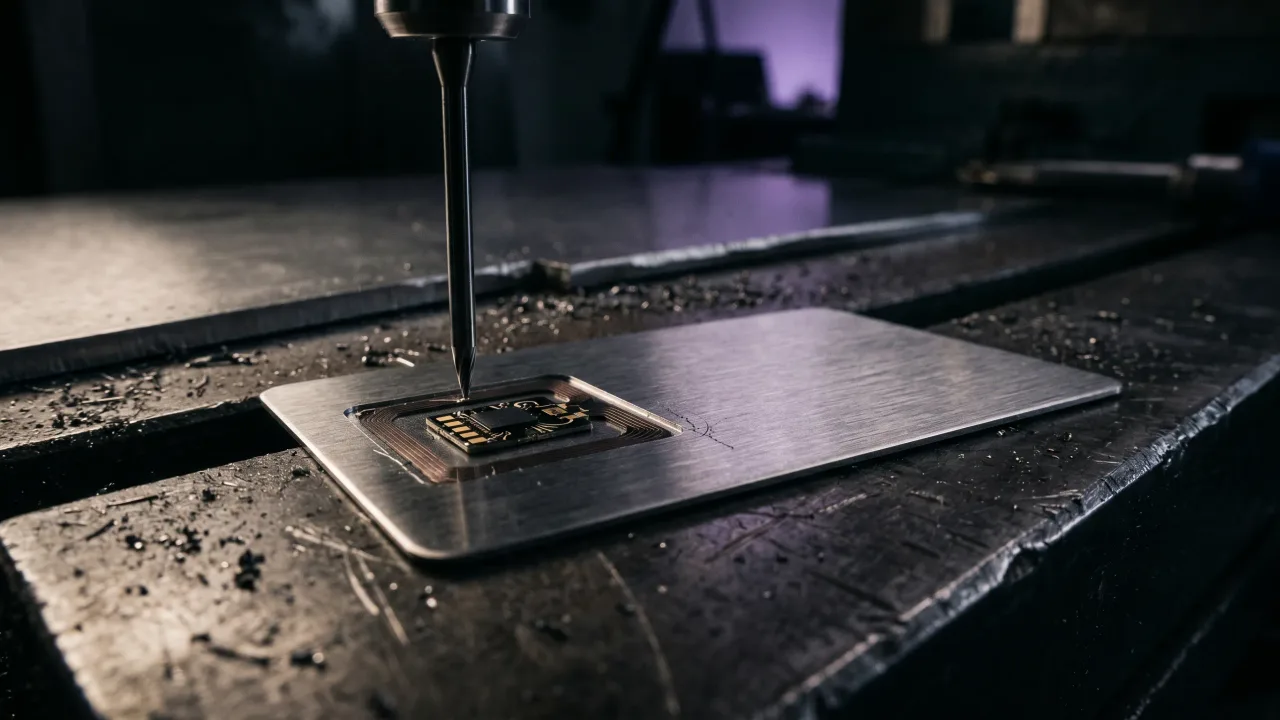
Then there is the chip. An NFC antenna is a coil of wire, and a bigger coil couples with a phone from further away. Antennas for these cards are wound to fill a CR80 outline. Shrink the card and you shrink the coil, and read range drops with it.
Business card sizes are not the same everywhere
Printed cards have no global standard. The US and Canada use 88.9 x 50.8 mm. Western Europe settled on 85 x 55 mm. Japan uses 91 x 55 mm for meishi, and Australia, India and New Zealand use 90 x 55 mm. Russia, Poland, Brazil, Mexico and South Korea sit at 90 x 50 mm.
Those numbers come from the regional table in the Wikipedia entry on business cards, and Adobe's size guide for designers lists the same spread. Six standards for one object.
If you hand cards to people in more than one country, CR80 solves the problem by ignoring it. Everyone already carries something that size, so nobody has to find a place for yours.
How thick should a metal business card be?
Thickness on the open market runs from 0.3 mm to about 1 mm, with 0.5 mm as the volume default. The differences are easy to feel and hard to describe in a product listing, which is why most listings skip the number entirely.
- 0.3 mm is shim stock. It flexes in a back pocket and holds the bend.
- 0.5 mm is the common compromise. Rigid enough to feel solid, cheap enough to sell in hundreds.
- 0.8 mm matches a bank card and stops flexing altogether. This is what we make in steel.
- 1 mm and above is an object rather than a card. It will not sit in a wallet with anything else.
There is no correct answer above 0.5 mm, only a trade between weight and stackability. Below 0.5 mm the trade stops being interesting, because a card that bends is a card someone throws away.
What thickness changes about the card
Weight is the obvious one. A 0.8 mm steel card in CR80 format lands at 25 to 30 grams. Heavy printed stock comes in around one and a half. That gap is the entire reason people keep metal cards on a desk instead of binning them.
Engraving depth follows thickness. A fibre laser can cut a deeper, higher contrast mark into thicker steel without heat warping the sheet. On 0.3 mm the same power setting starts to distort the card.
The chip cares too. An NFC inlay has to be isolated from the metal around it, and that isolation needs physical room inside the card body. Thin cards force compromises there, which is where intermittent taps come from. Our hardware specification lists the chip, the format and the tolerances we build to.
Does a metal business card fit in a wallet?
A CR80 card fits any wallet slot, because the slot was cut for that exact outline. A 3.5 x 2 inch card does not, and you find out after ordering five hundred of them.
Stacking is the second question. Three 0.8 mm cards make 2.4 mm, roughly three bank cards. Most people carry one and hand it over, so this rarely comes up, but it is worth knowing if you plan to carry a small stack to an event.
Cards nobody can carry do not get handed over. That is the whole test.
Custom shapes and cut-outs
Laser cutting will happily produce a logo-shaped card, a rounded square, or a card with your initial punched through the middle. The constraint is money and the antenna, in that order.
Tooling and setup for a non-standard outline get spread across the run, so a bespoke shape makes sense at a thousand cards and not at fifty. Cut-outs also have to stay clear of the antenna loop, which runs close to the card edge. A hole in the wrong place kills the tap.
Most of the visual difference people want from a custom shape is available inside a standard outline anyway. The design gallery covers what changes when you move the engraving instead of the edges.
What to check before you order
Ask for millimetres. "Credit card size" is used loosely and often means 3.5 x 2 inches, which is not credit card size.
Ask for the thickness as a number, and treat a refusal as an answer. Ask where the NFC antenna sits relative to the engraving, because a supplier who cannot say has bought the inlay in rather than designed the card around it.
Ask what happens to the card when the details change. On a Discard card nothing does, because the engraving carries a name and the digital profile carries everything that moves.
Size is the least glamorous spec on a metal card and the one that decides whether it survives. 85.6 x 54 mm at 0.8 mm is the answer for a card meant to be carried, because it borrows the format that wallets, card holders and terminals were all built around. The American 3.5 x 2 inch standard is a print convention that metal inherited by accident, and it costs the card its slot. If a supplier quotes inches, they are thinking about paper. If they quote CR80 and a thickness in millimetres, they are thinking about the object.
Build a card at full size and see the engraving on the real format before you spend anything.
Open the configuratorWhat is the standard size for a metal business card?
85.6 x 54 mm, the CR80 or ID-1 format from ISO/IEC 7810. It is the same outline as a bank card, which is why it fits wallet slots and card holders without modification. Some American makers use 3.5 x 2 inches instead, following the paper convention.
How thick are metal business cards?
Between 0.3 mm and 1 mm, with 0.5 mm the most common. Discard cards are 0.8 mm, which matches bank card thickness and removes any flex. Anything under 0.5 mm can bend permanently in a pocket.
Do metal business cards fit in a wallet?
CR80 cards do, because wallet slots were cut for that exact size. A 3.5 x 2 inch card is about 3 mm too wide and sits proud of the slot. Check the dimensions in millimetres before ordering.
Are metal business cards the same size as a credit card?
The good ones are. Both use the ID-1 format at 85.6 x 54 mm. Thickness varies more than width, since a credit card is 0.76 mm and metal cards range from 0.3 mm to 1 mm.
How much does a metal business card weigh?
A 0.8 mm stainless steel card in CR80 format weighs 25 to 30 grams. Wood composite versions come in at 8 to 12 grams. Printed card stock is under two grams, which is most of why people keep the metal one.
Can you get metal business cards in a custom shape?
Yes, though the economics only work at higher volumes because the tooling cost is spread across the run. Cut-outs also need to avoid the NFC antenna, which sits near the card edge. A hole in the wrong place stops the card reading.