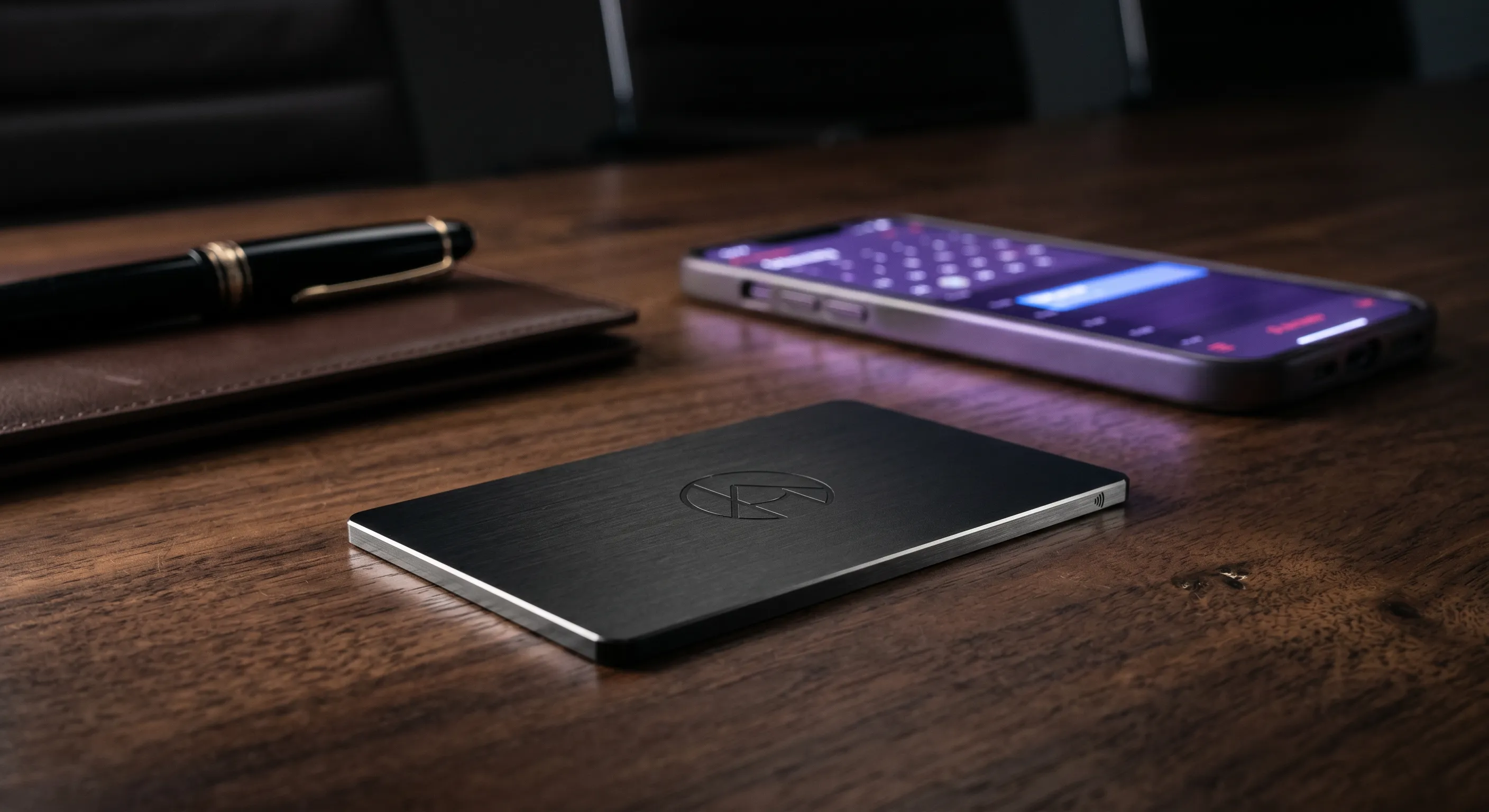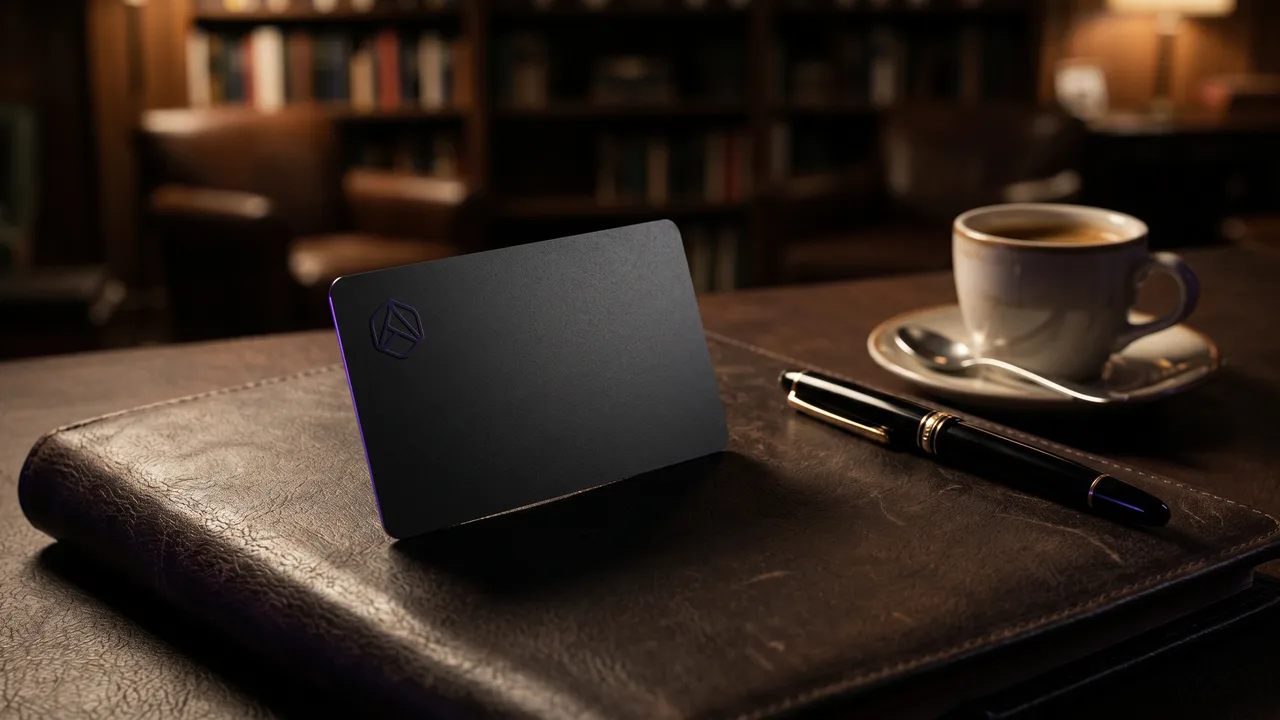
A working consultant or executive coach spends six to eight hours a week on business development, bills somewhere between €200 and €600 an hour, and hands out a card that cost less than the latte they bought before the meeting. The line item nobody runs in a professional services P&L is the cost of being forgettable on cardstock. An NFC business card for consultants and coaches turns the room introduction into a booked discovery call before the prospect leaves the building.
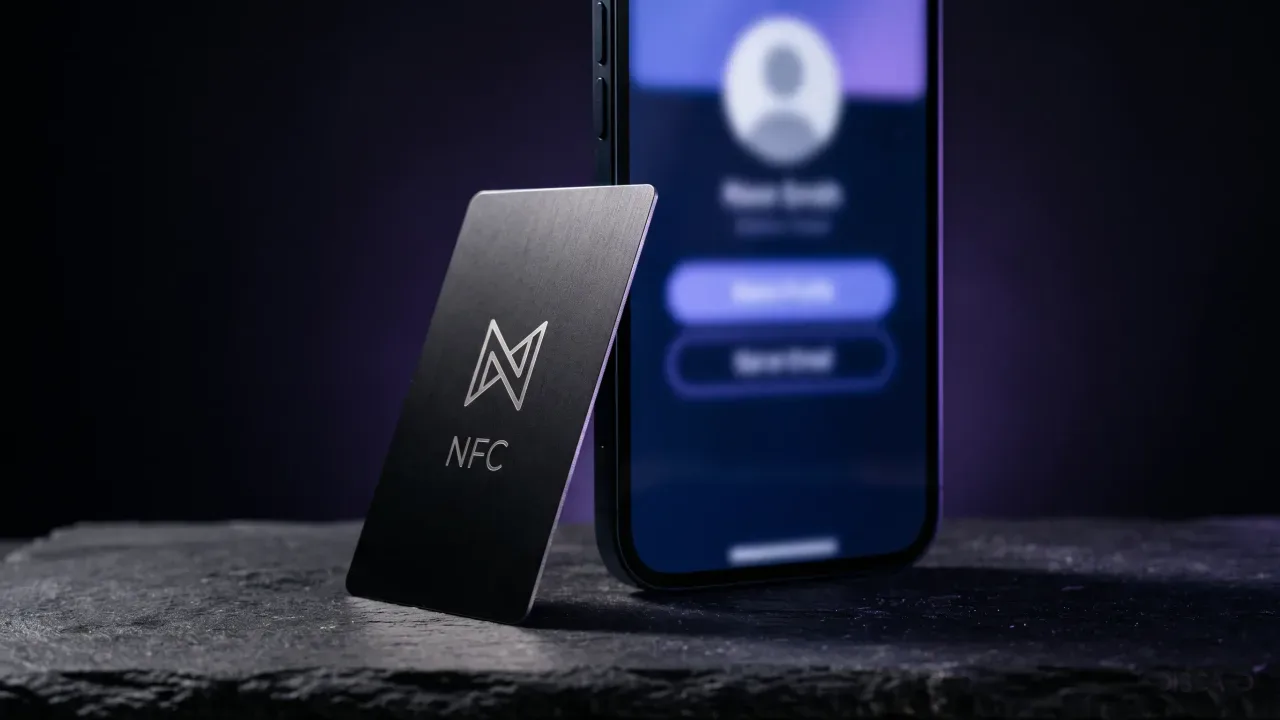
The fork is not paper versus digital. It is whether the object you put in a prospect's hand at the first meeting closes the gap to the next conversation, or asks them to remember to email you. A paper card asks. A Discard engraved metal card with an NFC chip closes. The recipient taps the card on the back of their phone, your calendar opens in their browser, and the discovery call is on both diaries before the small talk runs out.
The short answer: when a card converts the discovery call
An NFC business card converts the discovery call when the meeting is a first introduction and the prospect has not yet seen your work. That covers most networking events, advisory-board introductions, panel after-parties, keynote rooms, and one-on-one coffees that consultants and coaches actually live on. The tap turns goodwill into a calendar event in the prospect's browser, with the booking widget loaded before they have time to change their mind.
It is the wrong tool when the relationship is already established. A repeat client who has emailed you twelve times this quarter does not need a tap to find your calendar; they need a reply. The card belongs at the entry point, where the conversation either becomes a discovery call or quietly ends. For consultants running an outbound flow, the broader case for the format sits in the post on the NFC card for sales professionals; this piece is about what the card has to carry specifically when the product being sold is your hour.
The consultant's first 60 seconds before the proposal
A consultant sells a service that does not exist until somebody buys it. The prospect cannot test-drive a strategy engagement, and the discovery call is the first moment where the real product gets demonstrated. Everything before that call is a credibility filter. The handshake, the card, the website that loads in the lobby — each one trims or grows the chance that the prospect picks up your call on Wednesday.
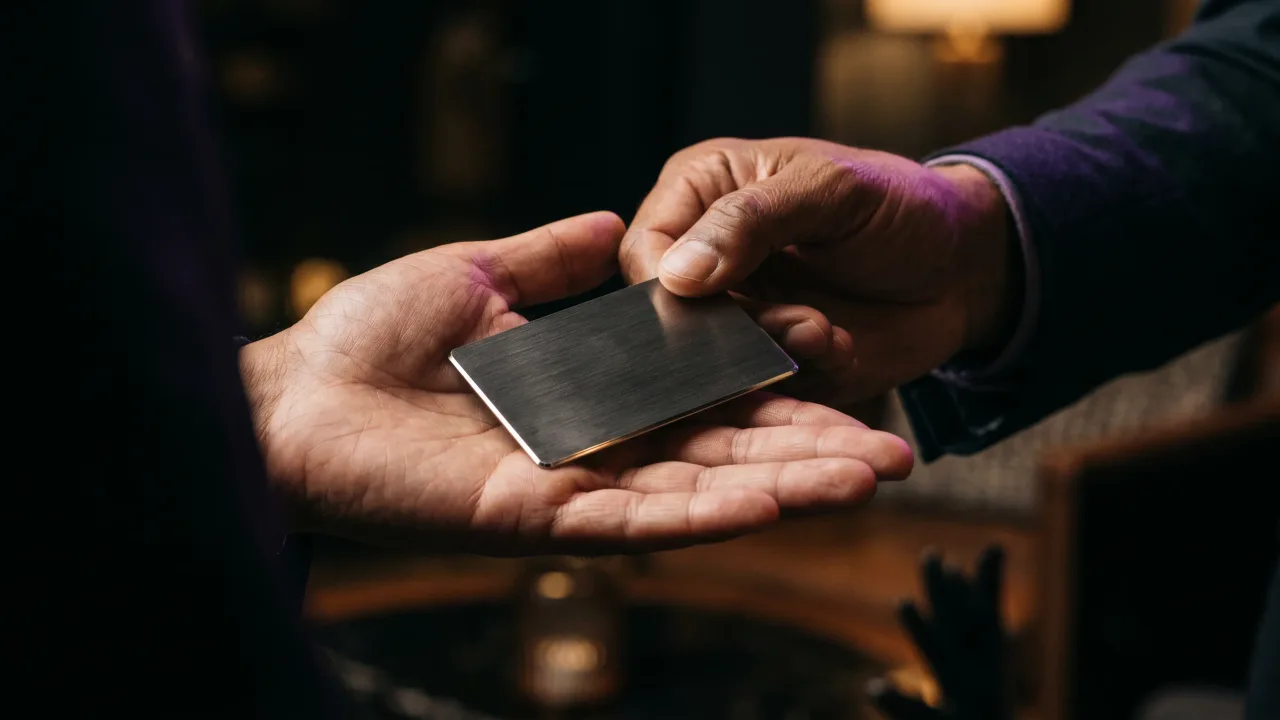
A paper card carries a printed phone number and a job title. It loses the credibility race against any prospect who has already pulled up your LinkedIn during the conversation. An engraved metal card carries weight, in both senses. The prospect lifts something solid, sees a wordmark that does not flake, and taps it to open a profile that loads a recent case study, a three-line bio, and a discovery-call booking link in under two seconds. Same 60 seconds, different signal. HBR's research on first-meeting pitches lands in the same direction: the credibility window closes early, and the props in your hand are doing more work than the words are.
The coach's leap from a keynote to a paid engagement
An executive coach has a different funnel and the same physical problem. The room is bigger, the questions land slower, and the moment of conversion is the queue of attendees who line up after a keynote or workshop to ask one more thing. The coach has roughly ninety seconds with each person before the next attendee shifts forward. Paper cards exchange hands in that ninety seconds and almost none of them survive the flight home.
An engraved metal card with an NFC chip stays on the desk through the seventy-two hours when the keynote is still fresh, and the tap during the conversation books the discovery call before the attendee has time to forget which session they attended. A profile built for coaches leads with a one-line credentialing claim, a calendar link with a free fifteen-minute window, and a short clip from the keynote the attendee just watched. The International Coaching Federation credentialing line carries weight on the profile in a way it never does on paper, because the prospect can click through to verify it without leaving the page.
What the digital profile leads with
The profile behind the tap is where the conversion happens, and the order of the elements is not the same for consultants and coaches. A management consultant leads with the credibility stack: prior firms, named engagements where the case study is public, a one-line offer for the current quarter. A leadership coach leads with the relational stack: a short video clip, an outcome statement from a current or past client, and the booking link set to a fifteen-minute introductory call.
Both profiles need the calendar widget above the scroll. Most prospects who tap a card never scroll past the first viewport. The booking link has to be the third or fourth element on the page, not buried under a feature list. The detailed structure of a profile that gets saved, with the section ordering and the link hierarchy, sits in the guide to digital business card profiles. The same patterns apply whether the role is consulting, coaching, or advisory.
Paper, plastic NFC, and metal NFC at a glance
The trade-offs across the three formats split cleanly. Cost, weight, durability, signal value, and update behaviour all move in different directions, and a consultant or coach picking a card for the next two years should know which axis they care about most.
| Factor | Paper card | Plastic NFC card | Metal NFC card (Discard) |
|---|---|---|---|
| Per-card cost | €0.50 to €2 | €15 to €25 | From €40 once |
| Lifespan | Six months in a wallet | Two to three years | Ten years plus |
| Signal at a senior introduction | Functional | Tech-forward, light | Established, weighty |
| Profile updates | None — reprint required | Live, profile-side | Live, profile-side |
| Calendar booking from tap | Not possible | Yes, via profile | Yes, via profile |
| Branding control for a firm | Per-print run | Subscription-locked tiers | Flat profile, central admin |
The retainer-rate signal you control before you speak
Consultants and coaches negotiate retainer rates against an expectation the prospect formed before the call started. The expectation comes from a handful of low-resolution signals: the introduction, the LinkedIn headline, the website that loads in the lobby, and the object that lands in the prospect's hand at the first meeting. A heavier, engraved object lifts the expectation by a measurable margin. Research from Yale's Joshua Ackerman and colleagues, published in Science in 2010, found that participants judged a candidate as more serious and qualified when the resume was handed to them on a heavy clipboard rather than a light one. Same paper, same words; the weight changed the rate the participant was willing to pay.
An engraved metal card is the heaviest object a consultant or coach hands across a table at a first meeting. It is also one of the few signals that arrives before the words do. The longer argument for the haptic effect sits in the post on the psychology of a premium first impression. For a coach negotiating a retainer above €5,000 a month, or a consultant pricing a Q3 engagement against three competing firms, the cost of the card relative to the rate it protects is in the third decimal place.
Solo practice, boutique firm, network of coaches
A solo consultant or coach orders one card, sets up one profile, and runs the dashboard from a phone. The cost is €40 once for the engraved card and €19.90 a year for the profile. Updates to the calendar link, the leading case study, or the credentialing line take under two minutes from a laptop or a phone, and the changes apply to every future tap on the same card.
A boutique firm with three to twelve partners orders the cards through the Teams flow, locks the brand mark and the firm wordmark across every card, and lets each partner edit their own profile from the dashboard. Central admin owns the brand; the partner owns the bio. A network of coaches running a shared lead-magnet, like a co-hosted workshop or a multi-coach directory, builds a single landing page on a shared profile path and routes each NFC card to the coach the lead is meant to land on. The setup for either pattern lives at the Teams page.
What an NFC card is not built to do
An NFC card is not a CRM, not a proposal tool, and not a substitute for a discovery-call script. The tap hands a clean record off to a CRM if one is connected, but the engagement gets worked in the system the firm already uses. A consultant who expects the card to write the proposal will be disappointed; a coach who expects the tap to qualify the lead will hear the same news.
It also does not work in rooms where every prospect carries a flip phone. NFC has been standard on iPhones since the XS in 2018 and on most Android handsets for longer than that, but a venue that skews older or technical-niche may still throw the occasional dead tap. The fallback is a printed QR on the back of the same card, or a short URL the prospect can type. Either keeps the card useful in the rare room where the tap does not fire.
The verdict
For a consultant or coach, the card is the only physical signal that arrives before the proposal does. Paper carries the credibility of a paper napkin. An engraved metal NFC card carries the credibility of the rate you are about to quote, and books the discovery call in the recipient's calendar before the recipient has time to decide they will email you later. Discard ships engraved metal NFC cards from the EU at €40 once with a €19.90 yearly profile that supports calendar booking, credentialing links, and Teams-managed branding for boutique firms. One card, every introduction, for the life of the practice.
Design an engraved metal NFC card and a profile that opens to a calendar-booking widget on the first tap. Five minutes in the configurator and the next discovery call books itself.
Open the ConfiguratorFrequently asked questions
Are NFC business cards worth the cost for a solo consultant or coach?
Yes for any practitioner who does more than a handful of first meetings a year. The card is €40 once and the profile is €19.90 a year, which means the full setup pays for itself the first time a tap converts a meeting to a paid discovery call. A solo consultant billing €300 an hour clears the first-year cost in under fifteen minutes of billable work.
Can a coaching client book a discovery call directly from the tap?
Yes. The profile behind the tap can lead with a calendar widget that loads in the recipient's browser, and the booking confirmation lands in both calendars without an email exchange. Most coaches set the first slot to a free fifteen-minute introductory call so the booking friction matches the room they handed the card in.
Do clients need to install an app to use a Discard card?
No. <a href="https://en.wikipedia.org/wiki/Near-field_communication" target="_blank" rel="noopener noreferrer">NFC</a> is built into every iPhone from the XS onwards and into most modern Android phones, and the recipient's device opens the linked profile in their browser the moment the card touches the back of the phone. No app, no account, no permission dialog at the booking moment.
How does an NFC card help a boutique consulting firm manage brand consistency?
The Teams flow locks the brand mark, the firm wordmark, and any required colour and typography choices across every card in the order, while each partner edits their own bio, credentialing line, and calendar link from the dashboard. The firm owns the brand layer; the partner owns the content layer. Central admin can swap a partner in or out without re-ordering the rest of the cards.
Can a coach show ICF or other credentials on the digital profile?
Yes. The profile supports a credentialing line with a click-through to the issuing body's directory, so a prospect can verify an ICF, EMCC, or ICR credential without leaving the page. A verified credential next to a calendar link does more for booking conversion than the same credential on the back of a paper card.
What happens if a prospect's phone does not pick up the tap?
The card carries a printed QR code on the back as a fallback, and the profile URL is short enough to type in a few seconds. NFC works on almost every modern phone, but the fallback covers the rare room where the tap does not fire — older handsets, deeply industrial venues, or devices with NFC disabled in settings.