Most clients meet their financial advisor once, like them, and then need their number eleven months later, when the annual review comes round or the markets have a bad week. By then the paper card is in a drawer, in a jacket that went to the dry cleaner, or gone. The advisor who gets the call is the one whose contact is already on the client's phone.
Digital business cards for financial advisors solve that specific problem. A tap or a scan opens a profile with your name, qualifications, registration details and a way to book a meeting, and saves your contact to the client's phone in one step. The part most vendors skip is that the profile is also a marketing communication, so the rules that already govern your website and your brochures apply to it too.
Why an advisor's card has to last longer than most
A salesperson's card has to work for a week, until the follow-up call. A financial advisor's card has to work for years. The relationship starts with one meeting and then runs on reviews, market wobbles, a house purchase, a pension decision and, eventually, a conversation with the client's children.
Trust carries more weight here than in almost any other trade. A client cannot judge your advice until years after they have followed it, so they judge what they can see today: your office, your manner, the way you answer a question you do not know the answer to, and the objects you hand them. A flimsy card with a mobile number printed in grey says very little about someone who wants to manage their savings. We looked at why that reaction happens in the psychology of a premium first impression.
Then there is accuracy. Advisors change firms, move offices, add qualifications and switch phone systems more often than their clients notice. A printed card freezes all of that on the day it was printed. A card that opens an editable profile keeps pointing to the right details for as long as the client keeps it.
The same applies across the trade. An independent advisor, an insurance agent, a wealth manager at a private bank and a bank advisor in a branch all sell something the client cannot inspect before buying. They all ask for trust after one meeting, and they all lose business when the client cannot find them a year later.
What a financial advisor's digital business card should include
Order the fields by what a cautious person checks first. They want to know who you are, whether you are allowed to do what you do, and how to reach you without being sold to.
- Full name and the job title your firm actually uses: financial advisor, wealth manager, insurance broker, investment consultant.
- Professional qualifications written out in full at least once, such as CFP, CFA or the local licence you hold.
- Your firm's name and its regulatory registration, with the register where a client can check it.
- The areas you work in, in plain words: retirement planning, mortgages and protection, investing for a first-time saver.
- Office address, phone and email, plus a link to book an introductory meeting.
- Any disclosures your firm requires on client-facing material, word for word.
- A link to your firm's website or a professional LinkedIn page you keep up to date.
Leave out anything that sounds like a promise. Past returns, a "top performer" badge, client testimonials and phrases like "guaranteed income" are where marketing rules bite hardest, and a profile is not the place to argue that yours is fine. Our general guide on what to include on a digital business card covers field order in more detail. For advisors the test is short: if your compliance team would strike it from a brochure, keep it off the profile.
Is a digital business card a marketing communication?
In most cases, yes. We make cards, we are not a regulator, so treat this section as orientation and ask your own compliance officer before you publish. Regulators care about what you say to clients and prospects. They do not care whether it is printed on card stock, engraved on steel or opened by a tap.
In the United States, broker-dealers work under FINRA Rule 2210 on communications with the public. It requires communications to be fair and balanced, and it requires a registered principal to approve retail communications before they are used. Registered investment advisers answer to the SEC's investment adviser marketing rule, which sets conditions on testimonials, endorsements and performance figures.
In the EU, Article 24(3) of MiFID II says that all information addressed by an investment firm to clients or potential clients, including marketing communications, shall be fair, clear and not misleading, and that marketing communications shall be clearly identifiable as such. Insurance distribution has a similar standard, and national supervisors add their own detail. In Bulgaria that supervisor is the Financial Supervision Commission, which also keeps the public registers of investment intermediaries and insurance brokers.
In practice, send the profile text to compliance for approval the same way you would send a new brochure, and keep a copy of what was approved. Route every later change the same way. An editable profile is only an advantage while the edits are signed off. Then check that the profile states the facts a regulator would expect to see, starting with your firm's name and registration.
Client data, privacy and what the chip actually stores
The NFC chip in the card stores a single web address. It holds no client data, it records nothing about who tapped it, and it cannot read anything from the phone that touches it. On our cards the chip is an NXP NTAG 215 with 504 bytes of memory, which is space for a link and very little else.
The client installs no app and creates no account. The tap opens a page in the phone's browser, and "save contact" downloads a standard vCard file into the phone's own contacts. From a data protection point of view that is the same exchange as a paper card: you hand over your professional details, and nothing about the client flows back. We cover the wider picture in whether digital business cards are safe.
Profile analytics count taps, profile views and contact saves. They do not identify the person who tapped. For an advisory firm that is a sensible limit, because the card never becomes a second, unmanaged store of client information that someone later has to account for.
Paper, digital-only or metal NFC for an advisory practice
| Paper card | Digital-only profile | Metal NFC card | |
|---|---|---|---|
| First impression | Forgettable unless expensively printed | None in person | Heavy, engraved, kept |
| Client saves your contact | Types it in, or loses the card | One tap, if they open the link | One tap |
| You change firm or office | Reprint the box | Edit the profile | Edit the profile, card stays valid |
| Compliance review | Each print run | Each profile change | Once for the engraving, then each profile change |
| Works at a seminar or dinner | Yes | Only if you send a link | Yes, tap opens the profile |
| Typical cost | Low per box, recurring | Profile fee only | €39.90–€49.90 once, plus the profile |
A digital-only profile is enough if nearly all of your new clients come through referrals by email or a website form. Put the profile link in your email signature and you are done. The metal card earns its price when you meet people face to face: first meetings, workshops, client events and the dinners where introductions actually happen.
For the material, black or silver metal suits most practices. Gold works for a private-banking feel and can look loud everywhere else. If you are looking for financial advisor business card ideas, the best ones are usually the plainest: your name and firm mark engraved on the front, a small QR code on the back, and nothing that dates. All eight finishes, with thickness and weight, are on the specs page, and our guide to engraved business card ideas shows which layouts hold up on metal.
Where the tap earns its place in an advisor's week
The first meeting is the obvious one. At the end, the client holds their phone to the card and your contact is saved before they have their coat on. There is no spelling out of a surname and no card left on the café table.
Seminars and workshops come next. An evening on retirement planning can put forty people in a room, and most of them will leave without speaking to you. A card on each table, or one you hold up at the end, lets anyone save your details in the time it takes to stand up. The chip needs no battery and no signal on your side. The other person's phone does the reading and opens the profile once it has a connection.
Networking events for financial advisors reward the same thing. A breakfast with local business owners or a chamber of commerce evening gives you three minutes per conversation. Ending each one with a tap means you leave with your contact on a dozen phones rather than a dozen cards in other people's pockets.
Introducers matter more to advisors than to most professionals. Accountants, lawyers and estate agents pass advisors' names on constantly. When an accountant hands a client your engraved card, they are vouching for you, and a card that weighs something in the hand backs them up. The same logic runs through our piece on NFC business cards for consultants and coaches, where the second conversation is where the work is won.
The quietest use is the next generation. When a long-standing client brings a spouse or an adult son or daughter to a review, that is the moment to make sure your contact lives on their phone as well. When savings pass to the next generation they often move to a new advisor, and the first one to go is the advisor the heirs have never met.
None of this needs an app. An iPhone XS or newer reads the card in the background, older iPhones back to the 7 read it from Control Center, and almost every Android phone with NFC reads it too. A small QR code on the back covers the few phones that cannot, or the client who would rather point a camera.
When you change firms: who owns the card?
Advisors change firms often over a career, and a move is when a card either helps or causes trouble. Before you order, settle one question with your firm: does the profile belong to you or to them?
If the firm owns it, the firm updates or redirects it when you leave, usually to a colleague who takes over your clients. Clients who kept your card still reach the firm instead of a dead number, which is what the firm is paying for. If you own it, read your employment contract before you point the profile at a new employer. Non-solicitation clauses and your regulator's rules on client contact after a move apply to a profile exactly as they apply to a phone call.
Firms ordering for a whole team usually choose the first model, with shared branding and one person managing the profiles. Our team orders handle the full roster in one order, so every advisor carries the same material, the same engraved layout and the same profile structure.
Mistakes that cost advisors credibility
The first is writing the profile like an advert. A long biography, a row of award logos and three competing buttons push the one thing a cautious client wants, a way to talk to you, below the fold. Keep the first screen to your name, your qualifications, your registration and one clear way to book a meeting.
Editing the profile without telling compliance comes a close second. The ability to change it in thirty seconds is the reason to have it, and it is also how an unapproved line about returns ends up in front of a client. Agree who can edit, and keep the approval trail.
The third is engraving what will change. An engraved mobile number, a job title you will outgrow or a firm you may leave becomes the one part of the card you cannot fix. Engrave your name and, if the firm owns the card, the firm's mark. Everything else belongs on the profile.
Personal social accounts are another trap. A client deciding whether to trust you with a pension does not need your holiday photos. Link a professional LinkedIn page if you maintain one, and leave the field empty if you do not.
And check your own card now and then. Booking links expire, offices move, a disclosure changes. Twice a year, tap your card with your own phone and read what a client sees.
How to set up the profile before your next client meeting
- Write one line on who you help, in the client's words: "Retirement planning for business owners", not "Holistic wealth solutions".
- Add your qualifications, your firm and its registration, and any disclosure your firm requires, word for word.
- Choose one route to a first meeting: a booking link or an office number, not both.
- Send the finished text to compliance and file the approval.
- Tap your card with an iPhone and an Android phone, save the contact, and check what landed in each phone's contacts.
The Discard digital profile covers all of this without an app on either side, and you can edit it whenever something changes. When you want the physical card, the configurator lets you engrave your name and firm mark on metal or wood and shows you the result before you order.
For a financial advisor who meets clients in person, a metal NFC card with a compliance-approved profile is worth having. The reason is practical rather than glamorous: it puts your contact on the client's phone at the first meeting and keeps it accurate through the firm changes, office moves and new qualifications that come with a long career. The profile is a marketing communication, so write it the way you would write a brochure your compliance officer has to sign, and leave out anything that reads like a promise about returns. If your clients find you only online, skip the card and put the profile link in your email signature.
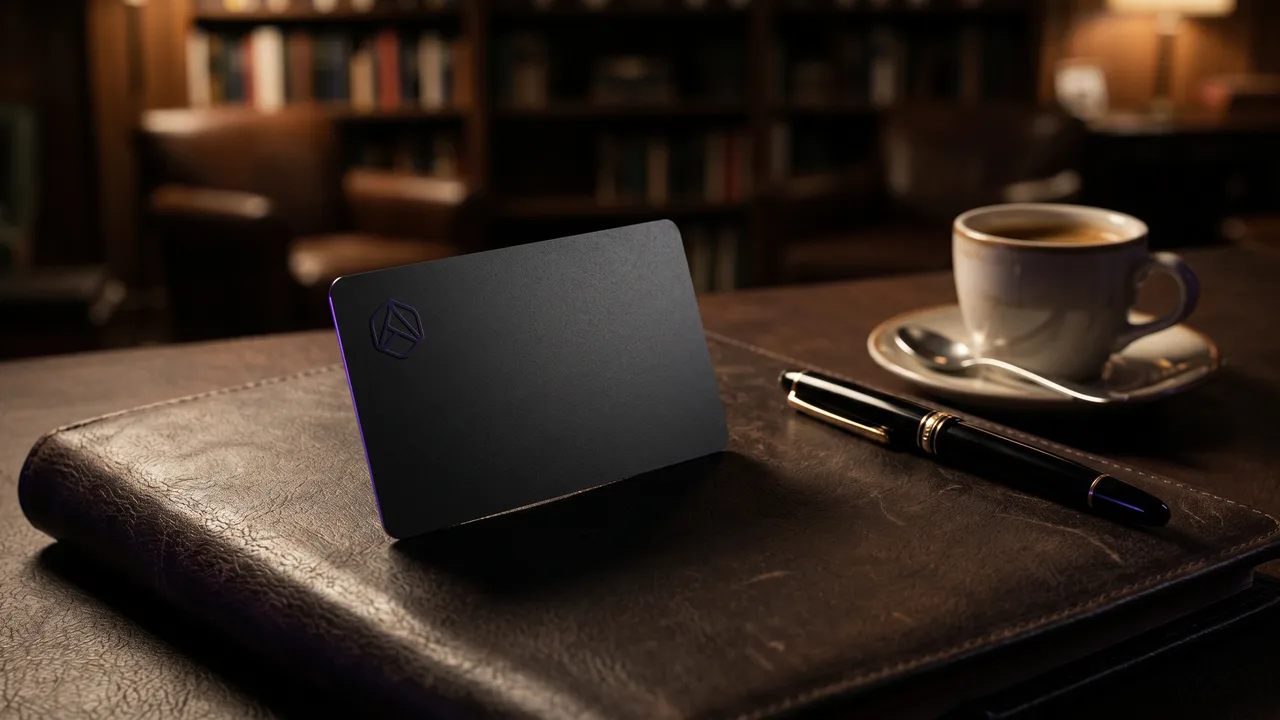
A metal card engraved with your name and firm, opening a profile you can update whenever compliance signs off a change.
Design your cardAre digital business cards compliant for financial advisors?
They can be, as long as the content meets the same rules as your other client-facing material. In the US that means FINRA Rule 2210 or the SEC marketing rule, and in the EU MiFID II's requirement that communications be fair, clear and not misleading. Have your compliance team approve the profile before you use it.
What should a financial advisor put on a business card?
Your name, title, qualifications, firm name, regulatory registration, office contact details and a way to book a meeting. Add any disclosure your firm requires. Leave out past returns, testimonials and anything that reads like a guarantee.
Does FINRA need to approve a digital business card?
FINRA Rule 2210 requires a registered principal at your firm to approve retail communications before use, and a profile shared with prospects can fall into that category. Your firm's compliance department decides how it is classified. Treat every later edit the same way.
Do clients need an app to open an NFC business card?
No. The tap opens your profile in the phone's browser, and saving the contact uses the phone's own contacts app. iPhone 7 and later and almost all Android phones with NFC read it, and a QR code on the back covers the rest.
Is client data stored on the NFC chip?
No. The chip holds only the web address of your profile. It records nothing about who tapped it and cannot read data from the client's phone.
What happens to my card if I move to another firm?
That depends on who owns the profile. If the firm owns it, the firm redirects it to a colleague. If you own it, check your contract's non-solicitation terms and your regulator's rules before you point it at your new firm.
How much do business cards for financial advisors cost?
Paper cards are cheap per box but need reprinting and re-approval whenever your details change. Our metal and wood NFC cards cost €39.90 to €49.90 once, and the digital profile is €19.90 a year.