Most advice on how to hand out business cards was written by the people who print them. Leave a stack at the dry cleaner, pin one to the café noticeboard, slip one into every birthday card. It is advice for moving paper, and it has very little to do with being remembered.
Handing out a business card is a small social move, and like most small social moves it has a right moment and a right sentence. Get either wrong and the card is in a bin by Friday. Get both right and the person keeps it, or, if the card is the kind that opens your profile with a tap, keeps you.
When to give someone your business card
Offer the card when a reason to stay in touch has appeared, not before. If you lead with it, the card reads as a sales call. If you wait until the other person has said something you can follow up on, the same card reads as a courtesy.
In practice the moment usually arrives near the end of a conversation, when someone says "send me that" or "we should talk more". The Emily Post Institute's guidance on when to offer a business card adds one rule about rank: if the other person clearly outranks you, let them ask for your card or offer theirs first. Pressing a card on a senior person five seconds into a chat is the fastest way to end it.
Asking is fine, and often better than assuming. "Can I give you my card?" costs nothing and gives the other person a graceful way to say they would rather connect on LinkedIn. Our guide on how to share your LinkedIn profile covers that fallback.
How to hand over the card itself
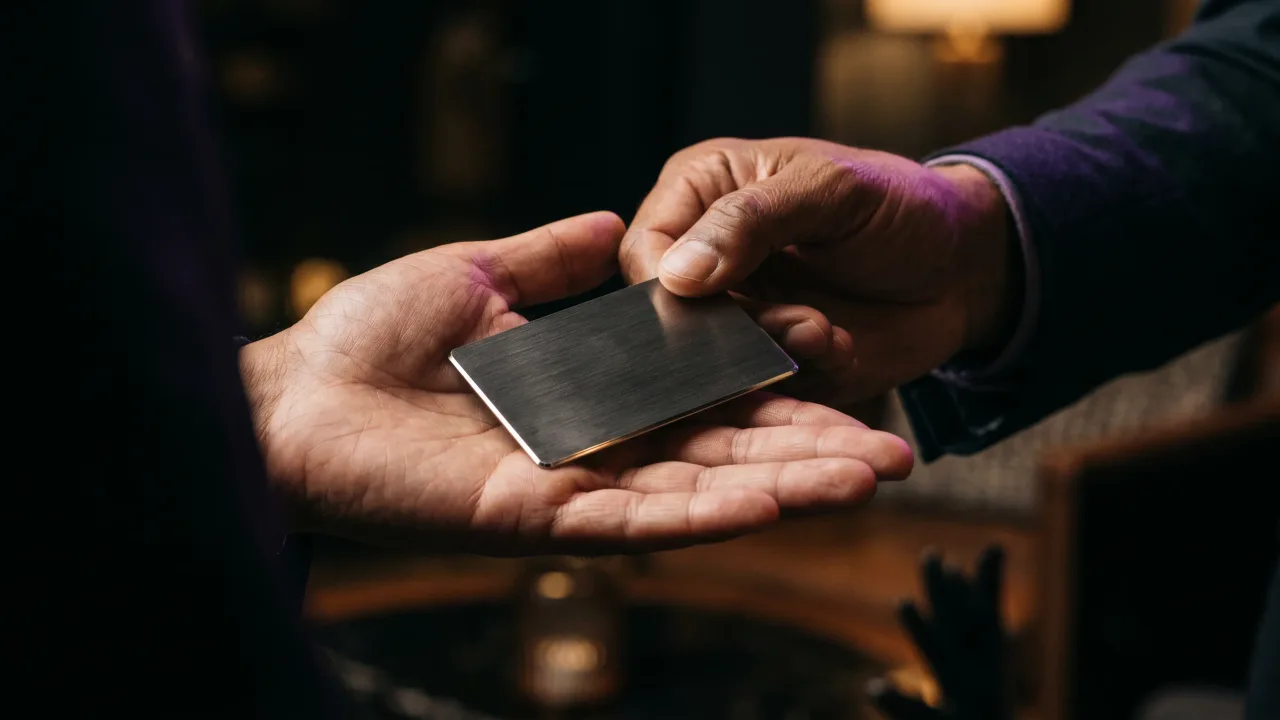
Hold the card so the text faces the recipient and is the right way up for them. Hand it with your right hand, or both hands if the setting is formal, and look at the person rather than at the card. Then say one sentence about why you are giving it. "My direct number is on there, call me about the Plovdiv project" does more work than any logo.
The two-hand version is not a flourish. In Japan the exchange of meishi has a full protocol, and the Wikipedia entry on business cards lays it out: present the card by its top two corners, receive it by the bottom two with both hands, read it, thank the person, and never cover the name with your fingers or write on the card. A card handed with one hand and pocketed unread is a small insult there. In Sofia nobody will take offence, but the idea travels: the card stands in for the person, so handle it the way you would like them to handle you.
Handing out business cards at networking events (and where not to)
A room with two hundred people in it is where most of the bad habits form. The temptation is to treat the evening as distribution and measure success by how few cards you take home. Nobody has ever won a client that way. The cards you hand to people who did not ask for them end up in the hotel bin along with the lanyard.
Aim for a handful of real conversations and give your card at the end of each one, to one person at a time. If you are talking to a group, offer each person their own card rather than fanning out a stack. If someone wants two for a colleague, they will say so; handing over several uninvited looks presumptuous.
How many business cards to carry depends on the event. For a day-long conference, ten to fifteen paper cards is plenty. For a dinner, three. Printers will tell you to always carry more than you need, which is true for the printer. The actual constraint is how many conversations you can have that deserve a card, and that number is rarely above a dozen.
Trade shows are the exception where volume is the point. There, a card on the stand's counter and one in every bag is fine, because visitors expect to collect. Everywhere else, including the bar after the trade show, go back to one card per conversation.
Not at a dinner that is not about business, until you are standing up to leave. Not at a wedding or a funeral at all. Not in the middle of someone else's pitch, and not to a person who has just told you they are leaving the industry.
The noticeboard, the counter stack and the windscreen are a different kind of mistake. Nobody minds them. They are decoration. A card nobody asked for carries no reason to call, and a card without a reason is paper. If you want local visibility, a Google Business Profile and a sign on the door do what the noticeboard was supposed to do, and they update.
How to receive a business card
Take it, look at it, say something about it. One honest sentence will do: "Oh, you're at the Lozenets office" or "Nice card". Then put it somewhere specific, a case or a jacket pocket you will check later. Pocketing a card unread, or dropping it on the table next to your drink, tells the giver exactly how much you plan to use it.
If you want to remember what you discussed, write on the back after the person has walked away, not in front of them. In Japan writing on a received card is a clear breach; elsewhere it is merely a little blunt. The habit that matters more is what you do with the card the next morning.
What changes when the card is a tap
Everything above was written for paper, and almost all of it still applies when the card carries an NFC chip. You still wait for the reason. You still hold it facing the person and say your one sentence. The difference is what happens in the next three seconds.
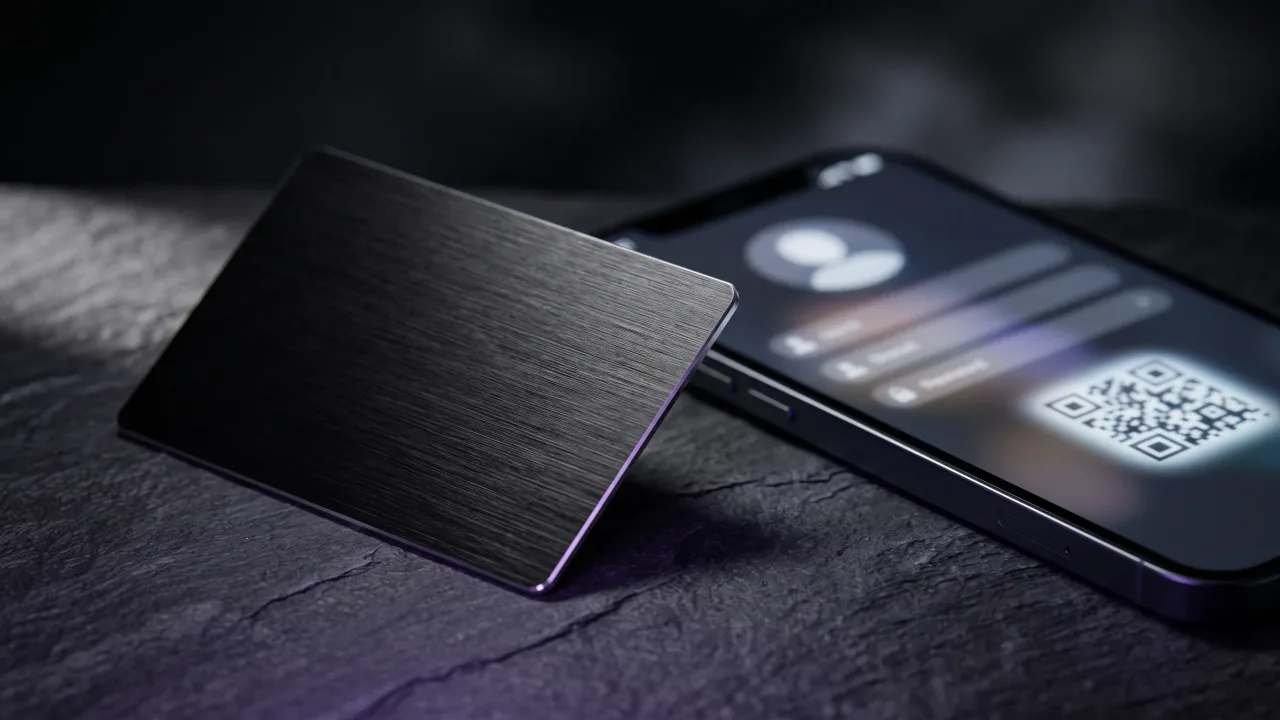
With a metal NFC card, the other person holds their phone near it and a digital profile opens in their browser: your name, photo, number, email, LinkedIn and whatever else you chose to show. They tap once more to save you to their contacts. There is no app to install and nothing to type, and the shoebox of cards never fills up. Then they hand the card back, and you give the same card to the next person.
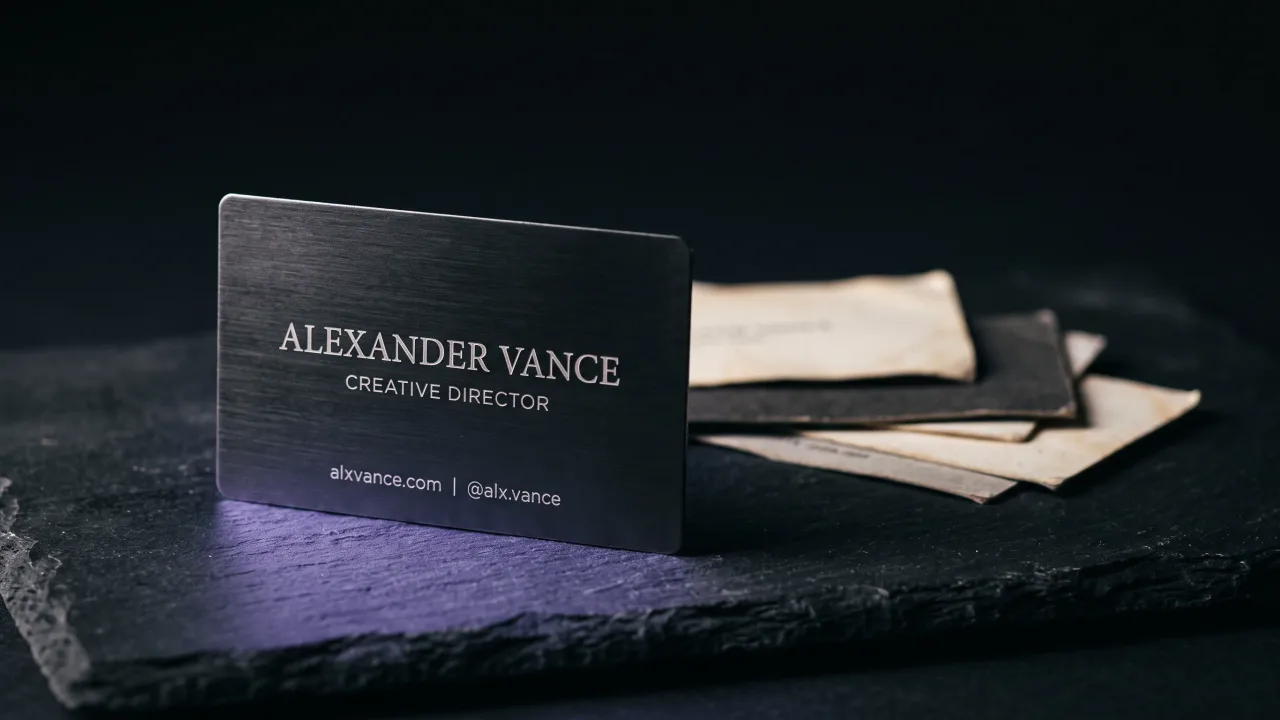
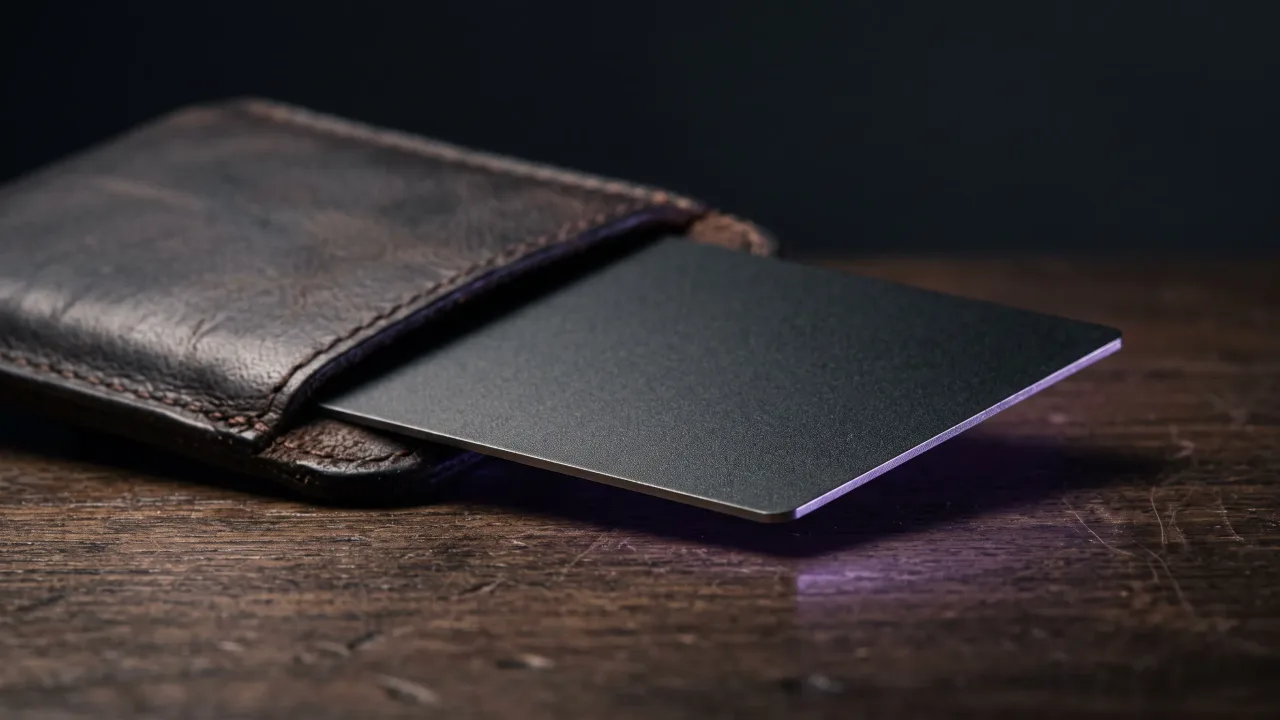
That last part changes the arithmetic. You carry one card instead of fifteen, so there is no stack to run out of and no reprint when your title changes. We ran the numbers on paper reprints in the hidden cost of paper business cards, and the three-year total for an active networker is several hundred euros. A card you keep is paid for once.
Two small adjustments to the etiquette. First, say what the card does before you offer it, because a surprise phone notification is slightly alarming: "Hold your phone against this and my details will pop up." Second, let them tap at their own pace rather than reaching for their phone. Some people would still rather have a card to keep, and every card we make has a QR code engraved on the back for exactly that moment. If you want to see how one is laid out, the configurator shows the front, the back and the profile it opens.
Follow up within two days
A card handed well and never followed up is a card handed badly with extra steps. Harvard Business Review calls failing to follow up the most common networking mistake, and the people who notice it most are the ones whose advice you asked for.
Send one short message within two days. Name where you met, repeat the one thing you promised (the article, the intro, the quote) and stop. If the card you gave was a tap, the other person already has your details saved, so the message is a reminder rather than a data-entry chore. If it was paper, type their details into your phone the same evening, before the card goes wherever cards go.
Hand out fewer business cards and hand them out later in the conversation than feels natural. Face the text towards the person, use both hands when the room is formal, say one sentence about why they should keep it, and treat the card you receive as if it were the person. None of that changes when the card is metal with a chip inside; what changes is that the contact is saved before you have finished the sentence, and the card comes back to you for the next conversation. We make those cards, so weigh our opinion accordingly, but the etiquette is older than we are and it works on paper too.
One metal NFC card that opens your digital profile with a tap, saves the contact and comes back to your pocket.
Design your cardWhen should you give someone your business card?
Near the end of a conversation, once a reason to stay in touch has come up. Leading with the card makes it look like a pitch. If the other person is clearly more senior, wait for them to ask or to offer theirs first.
Is it rude to hand out business cards at a party?
Not if you do it quietly, one to one, and save the business talk for another day. Do not produce a card at a dinner table that has nothing to do with work; wait until you are saying goodbye. Weddings and funerals are off limits.
How many business cards should I carry?
Three for a dinner or meeting, ten to fifteen for a full conference day. That covers every conversation worth a card and leaves no stack to run out of. With an NFC card the answer is one, because the card comes back after each tap.
What do you say when you hand someone your business card?
One sentence that gives them a reason to use it: "My direct line is on there, call me about Thursday" or "Everything is on my profile, hold your phone against it." Skip the job title, it is already printed.
Should you hand a business card with both hands?
In Japan certainly, and in much of East Asia, yes, with the text facing the recipient, and receive the card the same way. In Europe one hand is fine, but facing the text towards the person and looking at them while you do it still reads as respect.
Do you still hand over an NFC business card or just tap it?
Hand it over, say what it does, and let the other person hold their phone against it. The gesture of giving is the same as with paper; the card simply comes back afterwards. If they prefer something to keep, the QR code on the back opens the same profile from a photo.