Search "business card trends 2026" and nearly every result comes from a company selling the trend. Printers recommend foil. Paper suppliers recommend thicker paper. We make metal NFC cards, so read this one with the same raised eyebrow.
Take the sales pitch out and two kinds of trend are left: how a card looks, and what it does once it leaves your hand. The second kind matters more. And one trend, oddly for a bit of stationery, now has an EU law attached to it from 27 September.
The card turned into a link
The biggest change this year is not visual. A business card is now, more and more often, a way to open something, usually a profile or a booking page. The printed details are turning into the backup.
Two technologies do the opening. A QR code needs a camera and a steady hand, and an NFC chip needs a tap. Good cards carry both, because the person across the table decides which one their phone handles best and you do not get a vote. We compared the two properly in NFC versus QR code business cards.
What the code opens matters more than which code you pick. Point it at a page you can edit and the card stays correct when your job title changes. Point it at a frozen contact file and you have printed your details twice. That is why a digital profile sits behind every card we make.
A link also gives you something paper never did, which is a count. Our profiles log taps, opens and contact saves, so you find out whether the conference you paid for produced six conversations or sixty. A box of paper cards tells you only how many are left in the box.
Printers have noticed. The big online print shops now offer a QR code as a standard template option. Once something reaches a mass-market printer's default template, it has stopped being a trend and become normal.
Phones learned to swap contacts on their own
In 2023 Apple added NameDrop to the iPhone. Hold two phones close together and the contact cards cross over. Apple's own guide says NameDrop needs iOS 17.1 or later on both devices, and it sends only your name, the phone number or email you pick, and your contact poster.
It is a good feature, and phone makers clearly want the swap to happen with nothing in your hand. The catch is that NameDrop works only between Apple devices. Nothing built into Android does the same thing with an iPhone, so in any mixed room it quietly fails for everyone carrying an Android phone.
A card with a chip does not care. The reading phone opens a web page in its browser, and every phone has one. That makes the card the exchange method that works whatever brand the other person carries, which goes a long way to explaining why physical cards survived phones getting clever.
Thicker, heavier, and meant to be held
Of the design trends, weight is the one most likely to outlast the rest. Printers are pushing thick duplex stocks and painted edges. Their reasoning is that a card which feels substantial gets kept longer than one that bends in a pocket. Nobody has hard numbers on that, but anyone who has emptied a jacket after a conference has seen which cards survived.
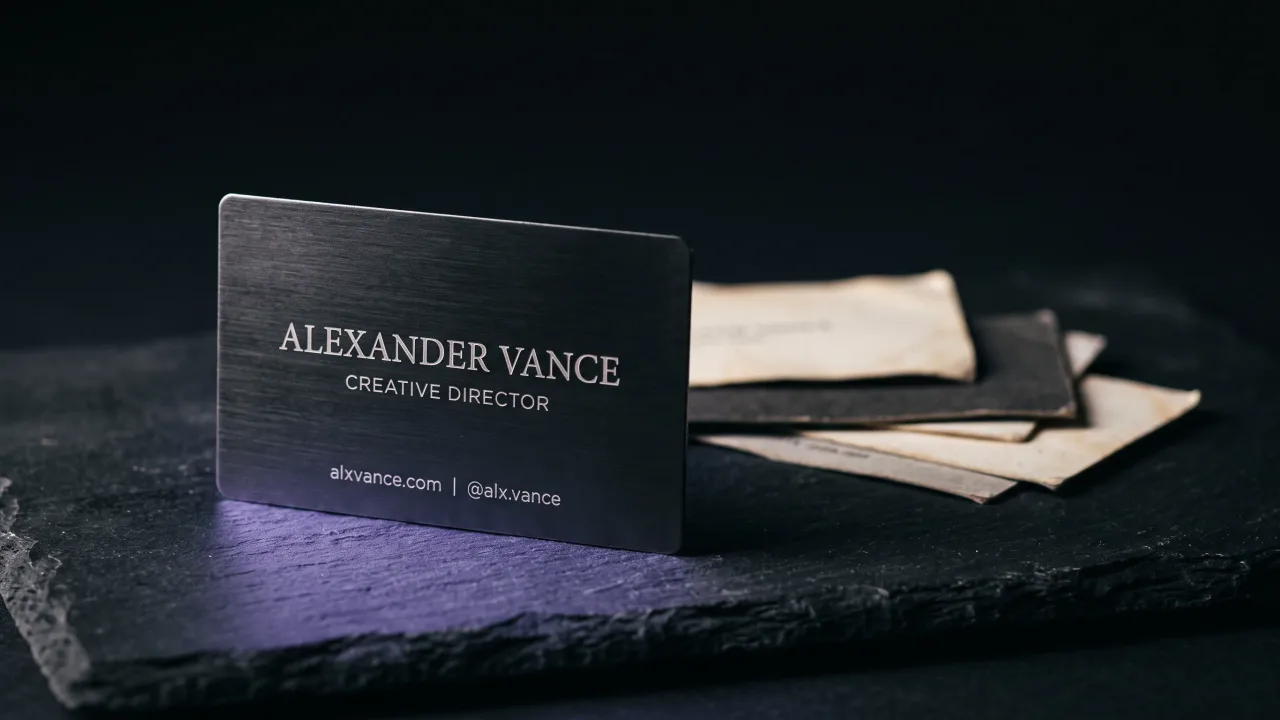
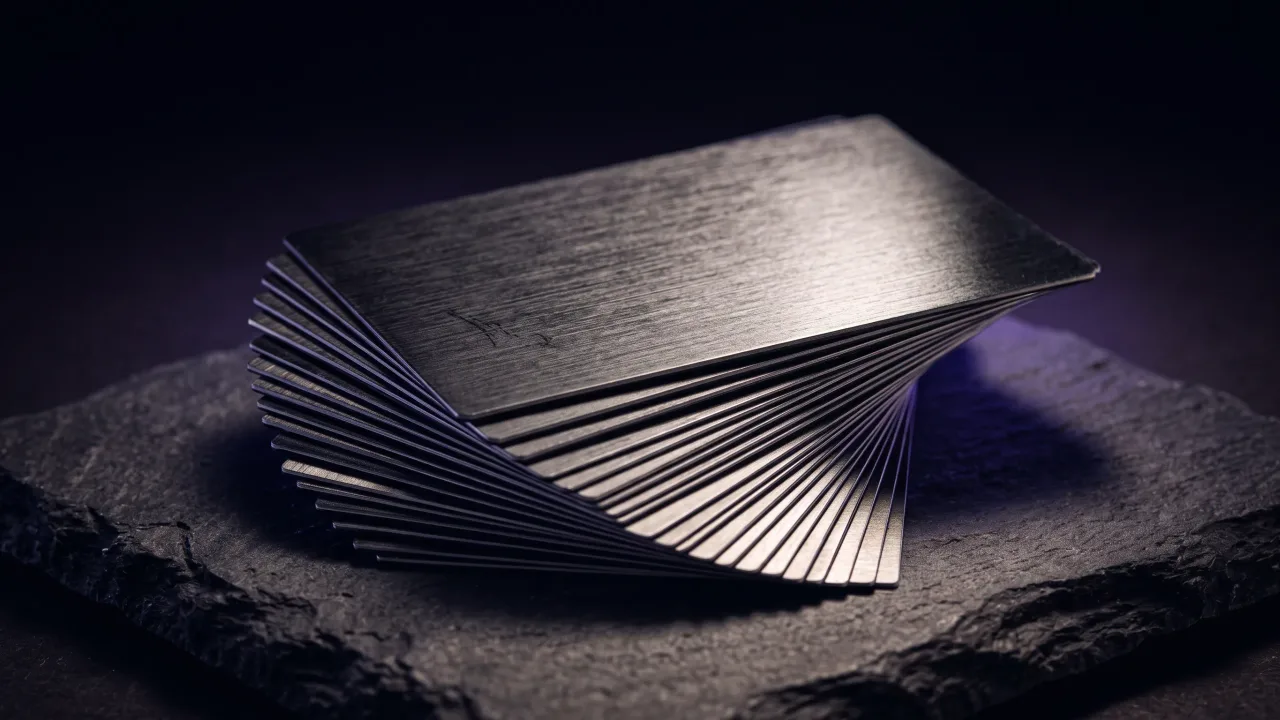
Metal takes that idea as far as it goes. A standard 350 gsm paper card weighs about 1.6 g. Our steel cards are 0.8 mm thick and weigh 25 to 30 g, so the other person notices the card before they read a word on it. Wood composite sits in between at 8 to 12 g, for people who want some heft without the shine.
Keep the format standard, though. Every card we make is CR80, 85.6 by 54 mm, the size of a bank card. Odd shapes look clever on a design portfolio and then refuse to fit a wallet slot.
Most of the real choice is in the finish. We went through finishes, layouts and the mistakes that cheapen a metal card in metal business card designs.
Minimal layouts, and a white Color of the Year
Pantone named PANTONE 11-4201 Cloud Dancer its Color of the Year for 2026 in December 2025. It is a soft white, the first white Pantone has chosen since it started naming a colour of the year in 1999. The pick split opinion online. For business cards it matched something that was already happening.
The layouts getting attention this year are quiet. A name, a role, one mark and a lot of empty space. Anything louder lives on the page the card opens.
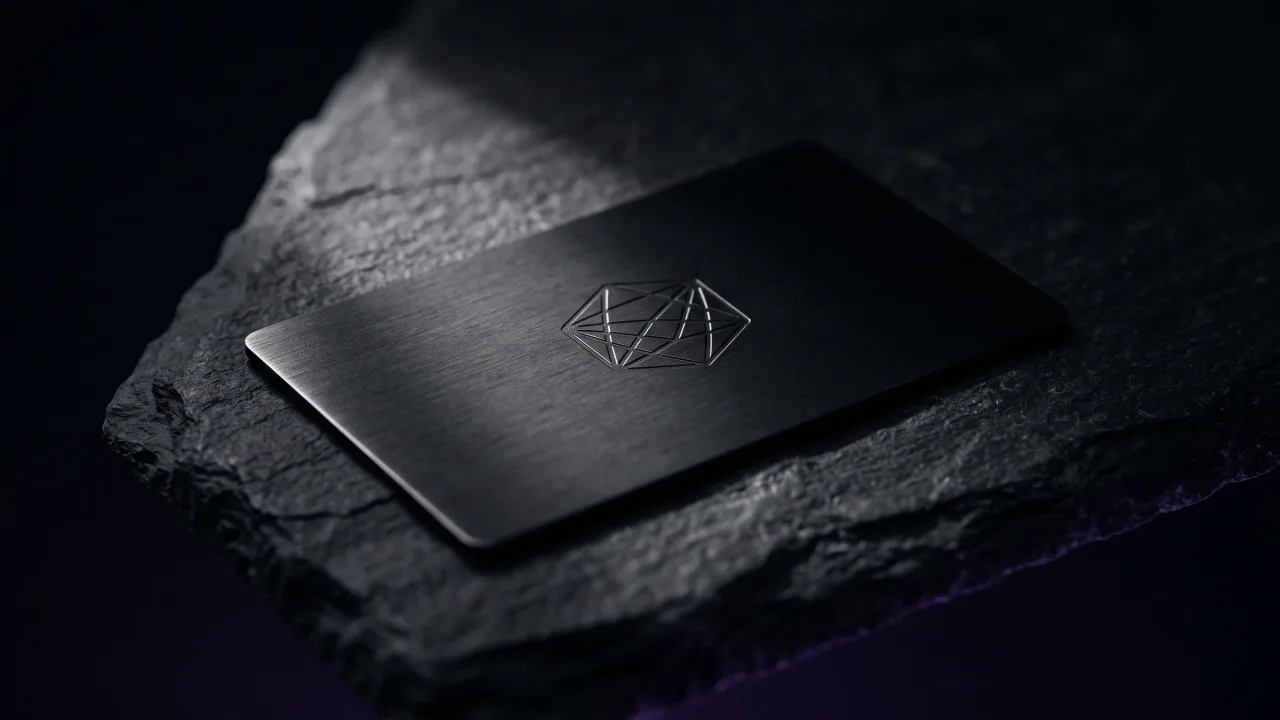
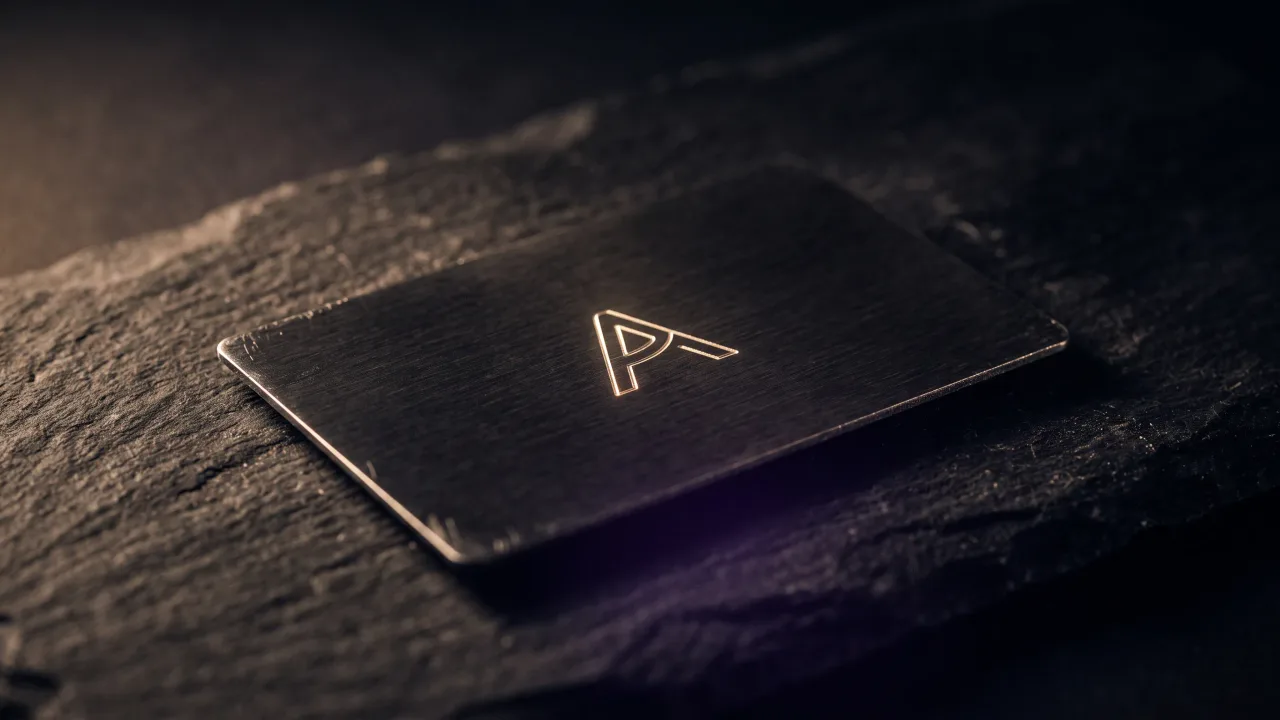
That split suits metal especially well. A laser engraves a clean wordmark beautifully and makes a mess of a crowded one, because small type fills in and long blocks of text blur together. Minimalism and the limits of engraving happen to point the same way.
The other look on most 2026 lists is industrial: brushed metallic inks, foil stripes, dark matte stock with a silver edge. It is paper trying to look like metal. That is a perfectly good look on a budget. If metal is the look you are after, though, a steel card starts at €44.90 and will not go soft and furry at the corners the way paper does.
Colour trends change faster than cards wear out. Put this year's colour on your profile, where you can swap it in January, and keep the card itself neutral.
"Eco-friendly" now needs proof in the EU
This trend comes with a legal deadline. Under Directive (EU) 2024/825 on empowering consumers for the green transition, from 27 September 2026 sellers in the EU cannot use generic environmental claims such as "eco-friendly" or "green" on consumer products unless they can prove them. Sustainability labels with no certification scheme or public authority behind them are banned as well.
Business cards have leaned on that language for years: seed paper, bamboo, recycled stock, "sustainable" wood. Some of those products really are better. From the end of September, in the EU, the claim needs evidence rather than a leaf icon.
We do not call our cards eco-friendly, and nobody should without a certificate to point at. Steel carries more carbon per gram than paper, so whether a metal card works out better depends on how many reprints it replaces, and that part is up to you. What we can say without a certificate is that a card you never reprint is one order, while a box of 500 paper cards is often the first of several.
Smaller orders, fewer reprints
The quietest shift shows up on the order form. Minimum runs of 500 made sense when people handed out 500 cards. Plenty of people now hand out far fewer.
Part of that is where introductions happen. Many start on a video call or in a message thread, and nobody needs a card for those. When the in-person meeting does come, it tends to count for more, and the card handed over at that moment is expected to be better than one of 500.
The other part is that printed details go stale. A new number or a promotion and the whole box is wrong. A card that opens an editable page survives both. We made the longer case for why the ritual outlived the cardboard in are business cards still relevant.
Companies can split the order the same way. Give everyone a profile, since a profile costs nothing to print, and send physical cards to the people who sit across a table from clients. The alternative is a box of 500 on every new hire's desk, still sealed on the day they leave.
Business card trends to skip in 2026
Not everything on the trend lists earns a place. These are the ones we would leave out.
- Holographic foil across the whole card. It looks great on a printer's website and like a gift voucher on a meeting-room table.
- Die-cut shapes that do not fit a wallet or a card holder. A card that cannot be stored is a card that gets thrown away.
- A QR code that opens your company homepage. The person scanning wanted you, not a cookie banner.
- Plastic cards painted to look like metal. People feel the weight within a second, and a fake finish undoes the point of paying for one.
- NFC chips with your contact details written straight into the memory. When your number changes the card is wrong, and you cannot fix it.
- Seed paper, unless you are honest with yourself about whether anyone plants it.
Each of these works better in a product photo than it does across a table.
What a business card needs on it in 2026
Less than it used to, because the printed side now has two jobs: tell someone who you are at a glance, and give them one reliable way to reach everything else.
- Your name, big enough to read at arm's length.
- Your role, in words a stranger understands.
- One mark or logo, simplified if it is going to be engraved.
- A QR code large enough for an older phone camera to read from across a table.
- An NFC chip that opens a page you control.
- One contact line if you like, for the person who will never scan anything.
Everything else belongs on the profile: extra phone numbers, the portfolio, the booking link, the socials. A profile has room for all of it and can change tomorrow. The card has 85.6 by 54 mm and has to stay right for years.
How to follow a trend without dating your card
Paper cards could chase trends because you reprinted them every year anyway. A metal card is meant to stay in your wallet for a long time, and that changes the rules.
Pick the trends that come from how people behave and pass on the ones about how things look this season. Tapping a card and quiet layouts will still make sense in 2030. Holographic foil probably will not.
Then put the fashion where it is cheap to change. The profile behind the card can carry this year's colour and next year's photo. The card only has to carry your name well.
If you want to see how that looks with your own name on it, the configurator shows the engraved card and a preview of the profile while you design both.
Most business card trends for 2026 are finishes a printer would like to sell you. A few are real changes in how cards get used, and those point the same way. The card is becoming a physical key to a page you can edit, and it is getting heavier and plainer while people order fewer of them. Phones did get better at swapping contacts, but only inside their own ecosystem, which leaves the card as the method that works between any two people. Our opinion, knowing where we sit: buy a card for the weight and the tap, keep the design quiet, and spend your appetite for trends on the profile behind it, where changing your mind costs nothing.
A quiet metal card that opens a profile you can restyle whenever the trends move on.
Design your cardWhat is the biggest business card trend in 2026?
Cards that open something. More cards now carry an NFC chip, a QR code or both, linking to a profile the owner can edit. The printed side gets simpler because the details live online.
Are business cards still used in 2026?
Yes, though fewer get handed out and each one is expected to do more. A card still works between any two phones, which built-in contact sharing like NameDrop does not.
Are QR codes on business cards worth it?
Yes, as long as the code opens a page about you rather than your company homepage. A QR code is also the fallback for phones with NFC switched off, so it belongs on an NFC card too.
Are metal business cards a trend or a fad?
We are biased, but the case for metal rests on weight and durability rather than a look, and those do not go out of fashion. What used to push people back to paper was details going out of date. A metal card that opens an editable profile removes that problem.
What should a modern business card include?
Your name, your role, one mark, and a QR code or NFC chip that opens your profile. Phone numbers, links and portfolio work go on the profile, where you can update them without reprinting.
Does NameDrop replace business cards?
No. NameDrop works only between Apple devices running iOS 17.1 or later, so it cannot swap contacts with an Android phone. An NFC card opens a web page in any browser, so it works whichever phone the other person carries.
What colour is trending for business cards in 2026?
White and off-white, helped along by Pantone choosing Cloud Dancer, a soft white, as its 2026 Color of the Year. A neutral card with one dark mark is also the safest choice for a card you plan to keep for years.