Search "NFC vs digital business card" and half the results will announce a winner. They are describing different things. The digital business card is the profile, a web page with your name on it. The NFC card is an object in your pocket that opens that page.
The industry sells them as rival products because they are sold by different companies. Underneath, one is software and the other is hardware, and asking which is better is close to asking whether you would rather own a song or a speaker.
What is actually being compared
A digital business card is a hosted profile sitting at a URL. Your name, title, phone number, links, a button that drops you into someone's contacts. It lives online, and you can change it after you have handed it out.
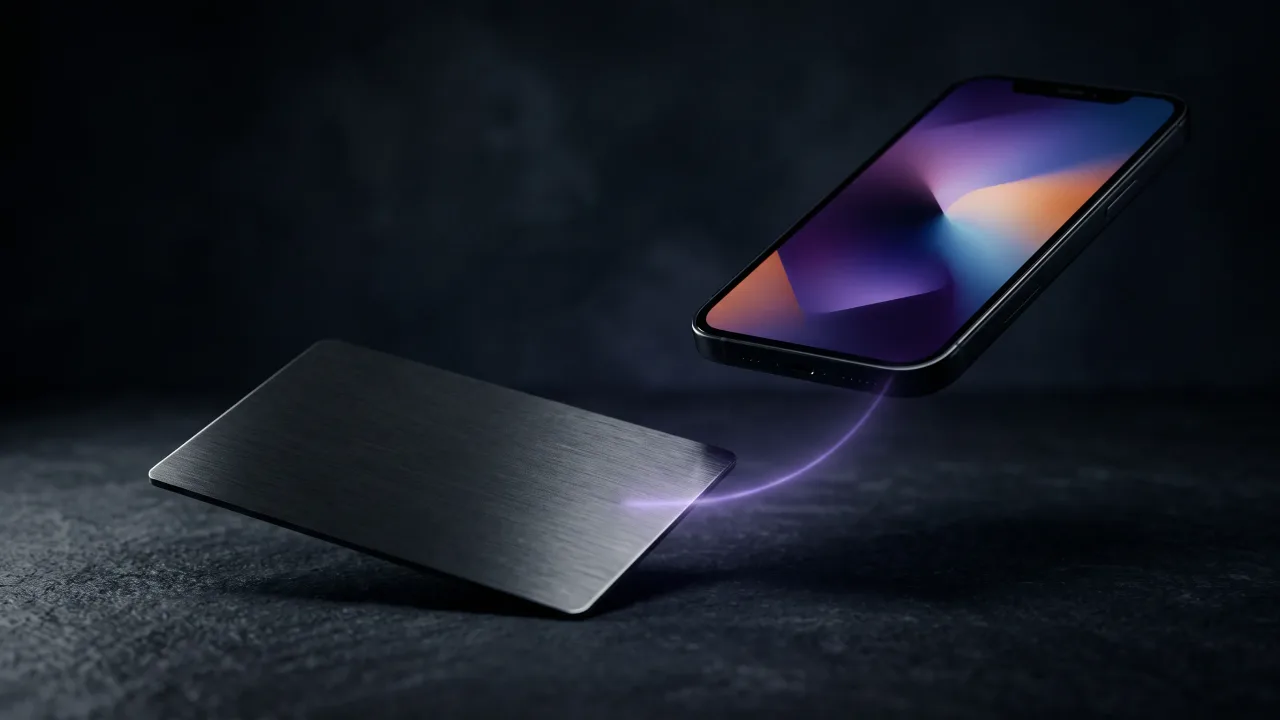
An NFC business card is a physical card with a chip inside it. The chip holds one short piece of text, which is almost always that same URL. Hold a phone against the card and the phone opens the page.
One is the destination. The other is a door. You can have the profile with no card at all, and plenty of people do. The reverse barely works: a chip with nothing to point at is an expensive coaster.
What a digital business card is
It is a page, not a file and not an app. Someone opens it in whatever browser their phone already has, reads your details, taps to call you or save you, and closes it. They install nothing. That last part is the whole reason the format works at all.
The useful property is that it stays editable. Change your title, swap the phone number, add the new portfolio link, and everyone you have shared it with sees the update the next time they open it. Paper cannot do that, and neither can a contact file someone saved in 2023. Our version of this is the Discard digital profile.
Saving still ends in a vCard, the small .vcf file your phone reads when it fills in a contact card. The profile generates one on demand rather than making anyone download it up front. We pulled the two apart in digital business cards versus vCards, and the vCard format has been a published standard since 1995, which is why it works on every phone without anyone agreeing to anything first.
How you share a digital business card is where it gets flexible. A link in a message, a QR code on your phone screen, a line in your email signature, a wallet pass, or a tap. The tap is the one that needs hardware.
What an NFC business card is
The chip is a passive tag, usually an NTAG from the same family that sits inside travel cards and event wristbands. It has no battery. Near-field communication runs at 13.56 MHz over a range of about four centimetres, and the phone's own field powers the chip for the fraction of a second it takes to read it.
What gets written to the chip matters more than the chip does. On a well-built card it is a link to your profile. On a cheap one it is sometimes your contact details typed straight into the memory, which means the day you change jobs the card is landfill. The NFC Forum tag specifications allow both, and only one of them is a good idea.
So ask what a card stores before you buy it. If the answer is anything other than a URL you control, you are buying a printed card with extra steps. The full mechanics are in how NFC business cards work.
The comparison table people came for
| Digital business card | NFC business card | |
|---|---|---|
| What it is | A profile hosted at a URL | A physical card holding that URL |
| Where it lives | Online | In your pocket |
| Typical cost | Free to a few euros a month | A one-off price for the object |
| Shared by | Link, QR, email signature, wallet pass | Tap, plus everything in the column to the left |
| Works when your battery is dead | No | Yes |
| Still correct a year later | Yes | Yes, if the chip holds a link rather than your details |
| Usual way it fails | Nobody opens the link you sent | It is in your other jacket |
Read the last row twice. Those are not the same kind of failure. One is an attention problem and the other is a logistics problem, and only one of them gets fixed by remembering something.
The sharing row is not symmetrical either. An NFC card inherits every method the profile has, because it opens that profile. The profile does not get the tap unless something physical exists to be tapped.
What a profile does that a card cannot
It travels without you. A great many introductions now happen in a chat window, an email thread, or a video call where nobody is in the same room, and a link works in all of those places. A card does not.
Duplicating it costs nothing. Twenty new hires get twenty profiles at no extra material cost, which is the argument for issuing profiles company-wide and cards only to the people who meet clients face to face.
Then there is the email signature, which quietly collects taps for months without you doing anything. Least glamorous sharing channel, often the busiest, and we get into it in using a digital business card in an email signature.
A digital business card without NFC is a perfectly reasonable product. If you never meet anyone in person, that is the whole answer and you can stop reading here.
What the card does that a profile cannot
It occupies a moment. Handing someone an object is a small ceremony that a URL cannot reproduce, and the object stays on their desk afterwards being a reminder. A link nobody opens leaves nothing behind.
The card also works when your phone does not. Flat battery, or a conference basement with no reception, and it still taps, because the reader is the other person's phone.
Then there is weight, which sounds like marketing until you watch someone hold one. A 0.8 mm steel card with a name cut into it lands differently from a plastic rectangle. That effect is real, and it is why we make the things out of metal you can pick a finish for.
And the exchange takes one motion instead of three. Nobody spells out a surname while somebody else types it into a phone, and nothing depends on a follow-up message that never gets sent.
Does it need an app, and does it work on every phone?
Nobody installs anything. An iPhone XS or newer reads a tapped card in the background as a system feature, and the iPhone 7, 8 and X read one through the Control Center NFC reader. Android has shipped NFC for well over a decade. The tag comes up as a notification, the person taps it, the browser opens.
The gaps are narrow and worth knowing. Very old handsets have no NFC radio. Some Androids ship with NFC switched off in settings. A phone in a thick case with a card wallet on the back sometimes needs a second try. That is the honest failure list, and it is short. The compatibility detail is in whether NFC business cards work with iPhone.
This is also why a good card carries a QR code as well. NFC business card versus QR code is a false choice for whoever is printing the card, because both fit on one object and the other person uses whichever their phone likes. The tradeoffs are in NFC versus QR code business cards.
How to pick what you actually need
If your work is remote and your introductions happen over email and video, buy nothing physical. Set up a profile, put the link in your signature, keep the QR code on your phone for the rare conference.
If you meet people in rooms, the card earns its price over the first handful of exchanges, provided the chip points at a profile you own. Whether it pays for itself in dry numbers is the subject of are NFC business cards worth it.
If you are outfitting a team, the split is usually obvious. Profiles for everyone, cards for the people who shake hands for a living. The profiles cost nothing to add and the cards go where they get used.
None of this is a bet on a technology. It is a decision about how many ways you want to be reachable, and whether one of them should be something you can hand over.
There is no contest here, because the two things do different jobs. The digital business card is the product: a profile you own, edit and share by whatever route suits the moment. The NFC card is the best delivery method for the one situation link-sharing handles badly, which is standing in front of somebody. Buy the profile first, because without it the card has nowhere to send anyone. Add the card when your work puts you in rooms with people. And check what the chip stores before you pay for it, because a card with your phone number burned into the memory is a paper card that costs more and cannot be corrected.
One profile you can rewrite whenever your details change, and a metal card that opens it in a single tap.
Design your cardWhat is the difference between an NFC business card and a digital business card?
A digital business card is the online profile that holds your details. An NFC business card is a physical card with a chip that opens that profile when someone taps it with a phone. One is the content, the other is a way of delivering it.
Do I need both?
No. A digital business card works on its own through links, QR codes and email signatures. The NFC card only adds something if you regularly hand an object to someone in person.
Can you have an NFC card without a digital business card?
Technically yes, because the chip can store raw contact details instead of a link. It is a bad idea. Details written straight to the chip cannot be changed later, so the card becomes wrong the moment your number or job title does.
Does the other person need an app to read an NFC business card?
No. Every iPhone from the XS onward reads a tapped card automatically, the iPhone 7, 8 and X read one through the Control Center NFC reader, and almost every modern Android reads tags with the built-in software. The card opens a normal web page in the phone's browser.
Is a digital business card cheaper than an NFC card?
Yes, and often free. You are paying for hosting rather than for an object. The NFC card costs what the material and the manufacturing cost, once, with no subscription attached unless the seller attaches one.
Which is better for networking events?
The card, comfortably. Nobody wants to type an email address into a phone while holding a drink, and a tap takes a second. The profile does the rest once the page opens.
What happens if someone's phone does not support NFC?
They scan the QR code on the card instead, which lands on the same profile. Any card worth buying prints one, precisely so the tap is never the only route in.
Can I update an NFC business card after it is printed?
You update the profile, not the card. The chip holds a fixed link, so editing the page behind it changes what every card you have ever handed out shows.