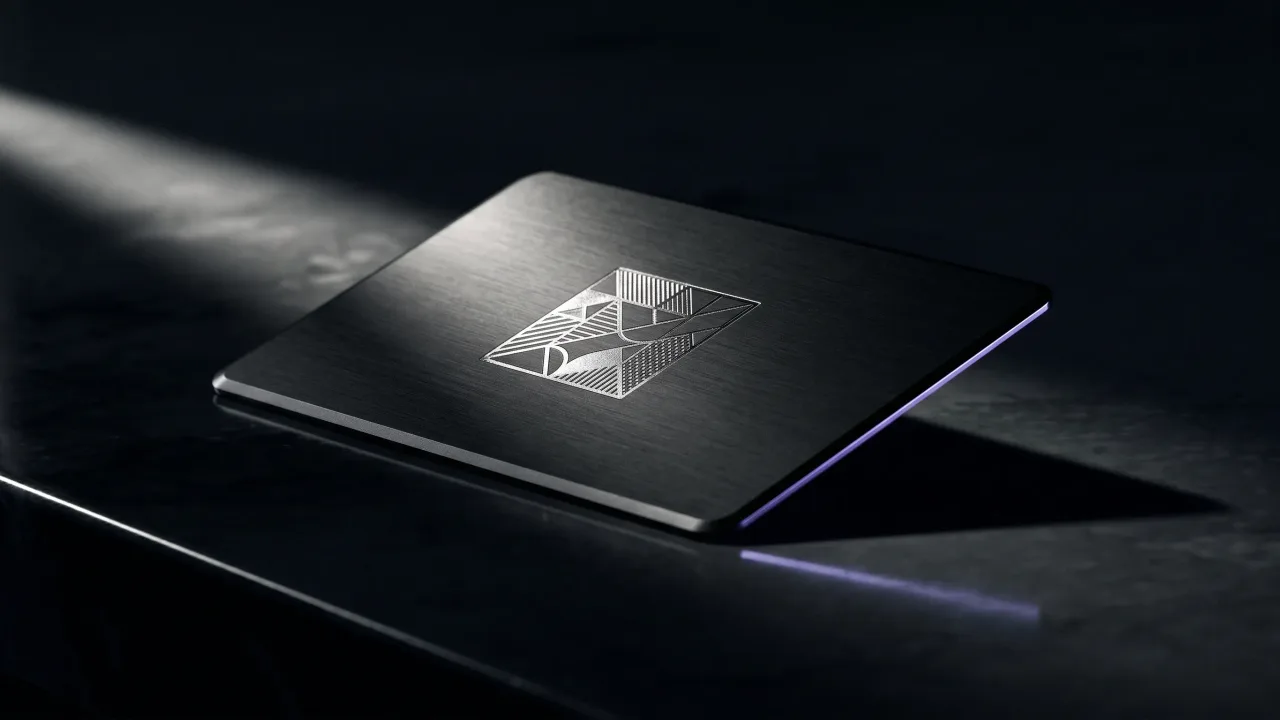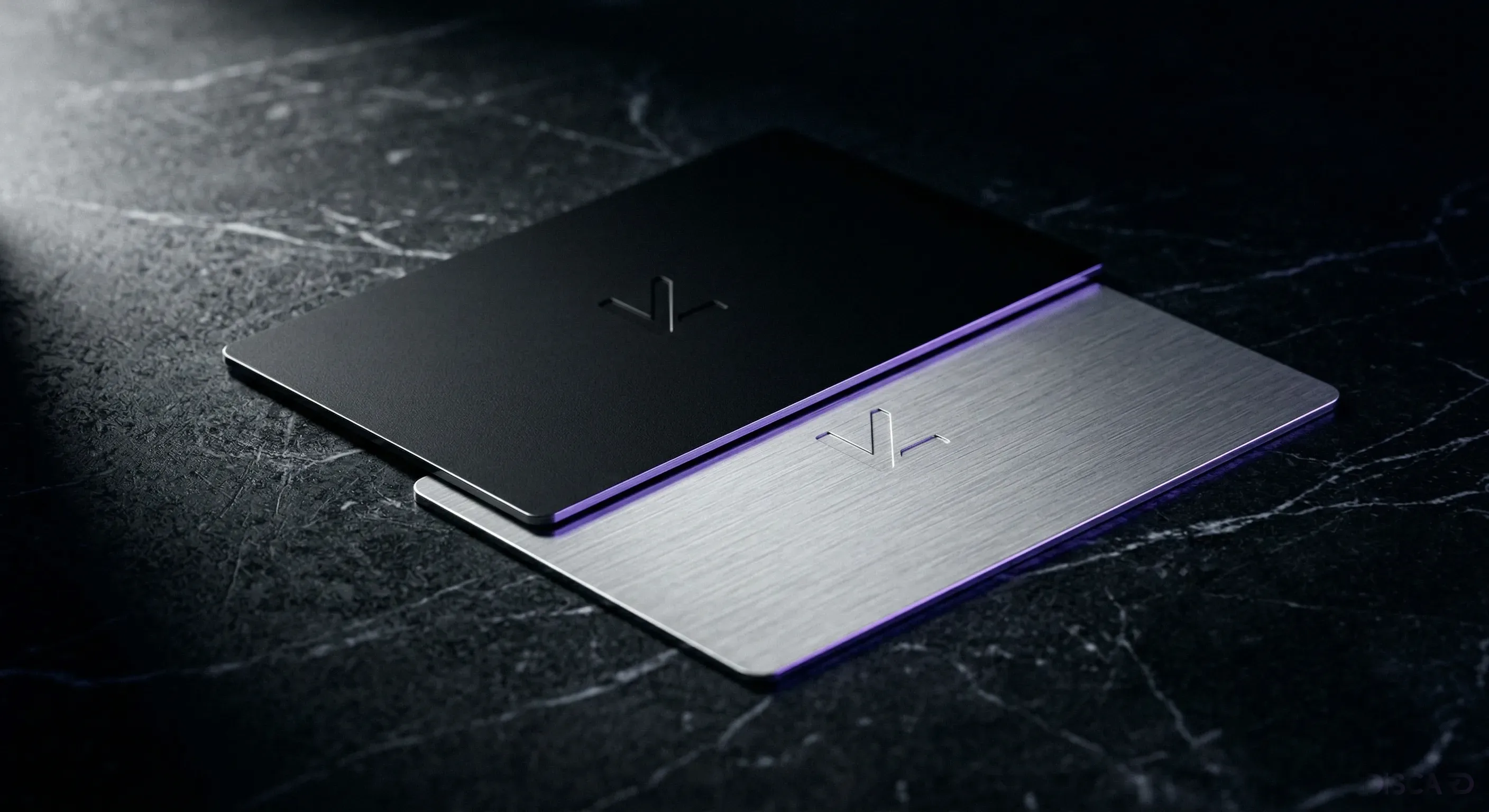
Three words compete for the same shelf: digital, electronic, smart. Vendors use them as synonyms. They are not. A digital smart business card is a physical object with a chip inside, and the person you hand it to taps their phone against it to open your profile. Everything else sold under that name is a web page.
The distinction decides what you are buying. One is a file. The other is a thing you put on a table. If you searched for a digital smart business card, you probably want the second one.
What a digital smart business card actually is
It is a standard business card, 85 by 54 millimetres, with a small antenna and chip laminated inside. The chip holds one short web link. When a phone comes within a few centimetres, it reads that link over near-field communication and offers to open it.
Nothing personal lives on the chip. Your name, phone number and links sit on a page you control, and the card only points at it. That is why you can change jobs on a Tuesday and the card you handed out in March still works on Wednesday.
Most cards use an NTAG213, NTAG215 or NTAG216 chip. The number is memory size, and a link needs almost none of it.
Digital, electronic, smart or NFC: which word means what
The vocabulary is a mess because three different products got marketed under overlapping names.
| Term | What it means in practice | Physical object? |
|---|---|---|
| Digital business card | A web page holding your contacts and links | No |
| Electronic business card | The same thing, usually just an older word for it | No |
| vCard / .vcf | A contact file a phone saves straight to its address book | No |
| NFC business card | A card with a chip that opens the page on tap | Yes |
| Smart business card | The retail name for the NFC card, often with a QR code on the back | Yes |
So a digital smart business card is really two products sold together: the chip-embedded card and the digital profile it opens. Buy one without the other and you have half a system. The physics of the tap is covered in what NFC business cards are.
How the tap works on iPhone and Android
Nothing pairs and there is no app to install. The phone powers the chip through the antenna for a fraction of a second, reads the link and shows a notification.
- iPhone XR and newer read tags with the screen on, without any app. The antenna sits at the very top edge, above the cameras.
- iPhone 7 to iPhone X can read cards, but you open Control Centre and use the NFC Tag Reader first.
- Android phones from roughly 2015 onward read tags automatically, usually from the middle of the back.
- They tap the notification, your profile opens in their browser, and one button saves you as a contact.
Behaviour is consistent across brands because the data format is a published standard from the NFC Forum. Google documents the reader side in its Android NFC guide.
If a tap does nothing, blame a thick case or NFC switched off in settings, not a dead card.
The profile behind the card is the real product
A chip that opens a badly built page wastes the tap. You get one screen and a few seconds of attention, and most templates spend both on a logo.
A profile worth tapping loads fast, puts a save-contact button above the fold, and shows only the links you actually use. Photographers need a gallery. Consultants need a calendar link. Nobody needs six social icons in a row.
Because the page is editable, the card stops being disposable. Edit one field and every card you ever handed out updates itself.
Smart card, QR code or paper
QR codes do most of what a chip does, and a printed code costs nothing. The gap is the handoff, not the technology.
| Smart card | QR code on paper | Paper card | |
|---|---|---|---|
| Exchanging a contact | One tap | Open camera, aim, scan | Type it in manually |
| Changing your details | Edit the profile | Reprint everything | Reprint everything |
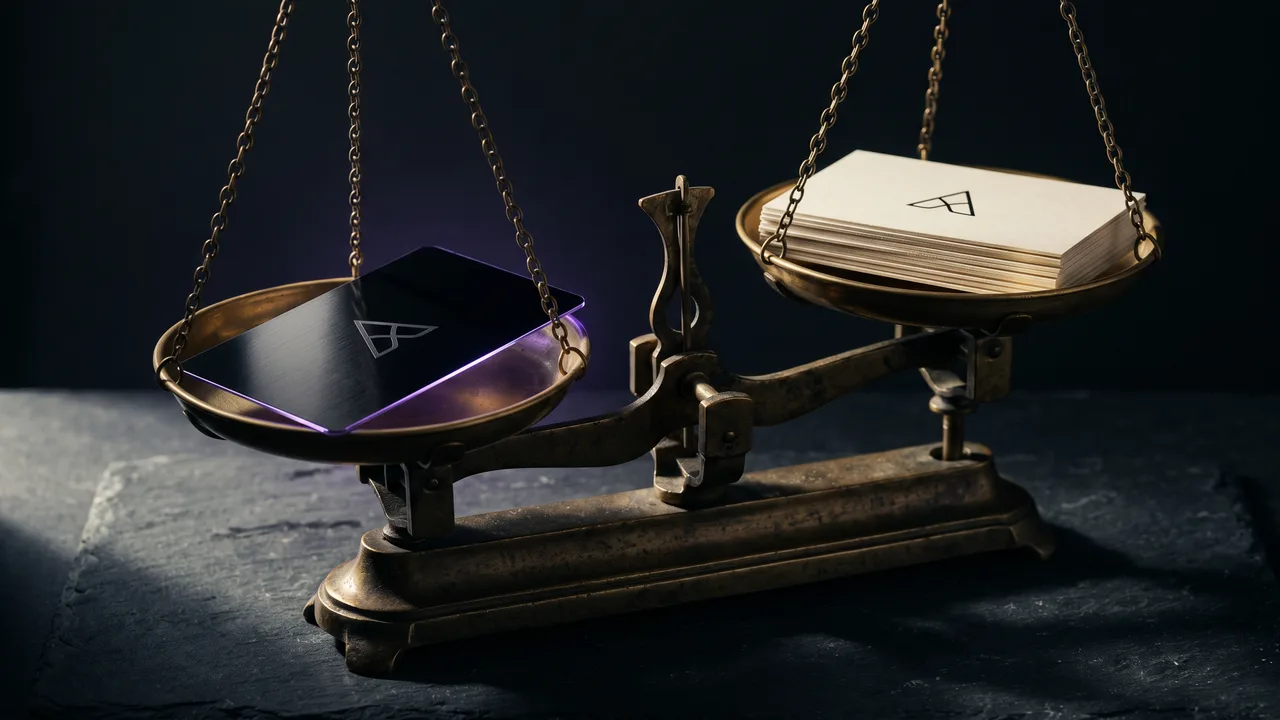
| Useful lifespan | Years | Until something changes | A week in a drawer |
| Reaction when you use it | People ask about it | None | None |
| Cost over three years | One card, no reprints | Repeat print runs | Repeat print runs |
Good cards carry both: the chip for phones held close, a QR code on the back for someone photographing your card across a table. Full comparison in NFC vs QR code business cards.
Why the material decides whether people keep it
The chip is identical in a two-euro PVC card and a fifty-euro metal one. What differs is the four seconds after you hand it over.
PVC feels like a loyalty card, and people treat it like one. Wood is warmer but scratches and warps. Stainless steel and black-coated metal have weight, and weight is what makes someone turn the card over instead of pocketing it.
That reaction is the whole point of a physical card when you could just send a link. The Bulgarian smart card market carries both kinds at similar prices.
What a digital smart business card costs
Printed PVC cards sit at the bottom of the Bulgarian market and metal at the top, with most sellers bundling the profile into whichever you pick. Headline price alone tells you very little.
A Discard card is €39.90 to €49.90 depending on the metal, engraved and programmed before it ships, with the first year of profile hosting included. The profile then renews at €19.90 a year, or costs €19.90 on its own without a card.
Check two things in any quote: whether the profile is included, and whether the price is per person per month. Per-seat pricing is where a cheap card becomes an expensive one. The three-year arithmetic is in are NFC business cards worth it.
How to get one made
Build the page first, then commit it to metal, because engraving is permanent and a profile is not.
- Write your profile: name, title, one clear photo, the two or three links you genuinely use.
- Pick a material and decide what gets engraved. Name and title survive a job change. A phone number often does not.
- Check the layout at actual size, because engraving that looks fine on screen can be unreadable at 85 millimetres.
- Order, then test the card against your own phone the day it arrives.
- Keep a QR code on the back for people who never get close enough to tap.
The whole thing takes about ten minutes in the card configurator, most of it spent deciding what to leave off.
A digital smart business card earns its price if you meet people often enough that the object gets used. What you are buying is a better handoff, not better technology, since a QR code moves the same data for free. Ignore the chip spec sheet, because NTAG213 and NTAG216 are indistinguishable in use. Spend the money on the material and the profile. A well-built page on a plastic card still beats a beautiful metal card pointing at a template nobody scrolls. If you can only get one right, get the page right.
Build the profile, then put it on metal. Engraved, programmed and tested before it ships.
Design your cardFrequently asked questions
What is the difference between a digital business card and a smart business card?
A digital business card is a web page holding your details. A smart business card is a physical card with an NFC chip that opens that page when tapped. One is the object, the other is the content, and most sellers bundle them.
Is there a monthly subscription for a digital smart business card?
It depends on the seller. Discard charges once for the card, includes the first year of profile hosting, then renews at €19.90 a year. Check whether a quote is billed per person per month, because that is where costs compound for teams.
Can I change the information after the card is made?
Yes, as long as the chip points at a hosted profile rather than storing your details directly. Edit the page and every card in circulation reflects the change. Anything engraved is permanent, which is why phone numbers are better left off.
What happens if the other person's phone has no NFC?
They scan the QR code printed on the card, which opens the same profile. Most phones in current use support NFC, so this comes up rarely, but a card without a QR fallback occasionally fails.
How much does a digital smart business card cost in Bulgaria?
PVC versions are the cheapest tier on the Bulgarian market and metal is the most expensive. A Discard metal card with a hosted profile is €39.90 to €49.90, engraving included. The spread reflects material and finish rather than any difference in the chip.
Are digital smart business cards secure?
The chip holds only a public web link, so there is nothing on it to steal and no way to pay with it. What matters more is what your profile page collects and where it is hosted. Read the privacy policy before publishing personal details on any provider's platform.